为什么输出结果是hello,而不是hellow,我附了张图片。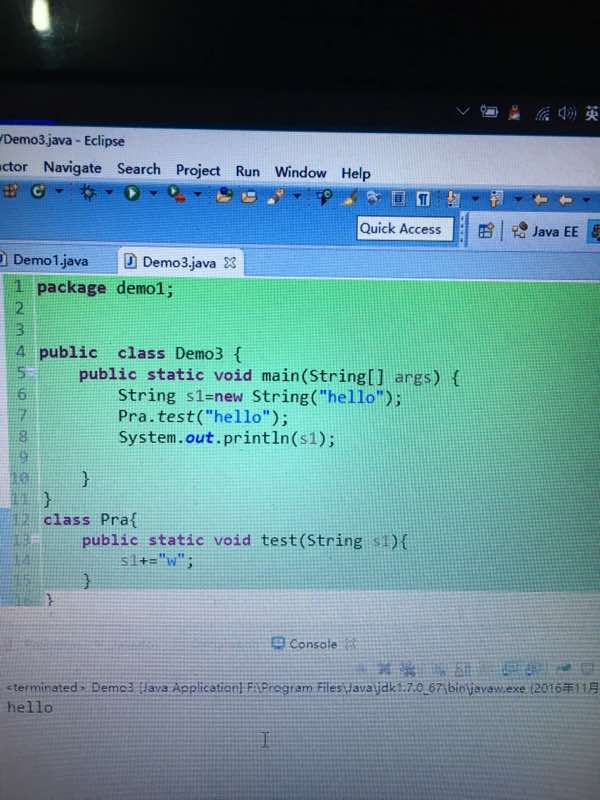

关于string的问题,求解,求解,求解

- 写回答
- 好问题 0 提建议
- 关注问题
 分享
分享- 邀请回答
-

17条回答 默认 最新
 思想永无止境 2016-11-24 05:33关注
1.在一个方法内对一个参数的引用重新赋值对原对象是没有任何影响的。
2.要想对原对象产生影响,你只能对该参数引用指向的对象内部进行修改
如:public static void test(StringBuilder sb){ sb.append("w"); } public static void main(String[] args) { StringBuilder sb = new StringBuilder("hello"); test(sb); System.out.println(sb); }3.String是不可变对象,它没有提供任何可以修改自己的方法。
4.new和双引号创建String的区别在于new会在堆和常量池里都创建一个String,双引号就只在常量池里创建。
5.如果一定要改怎么办?
5.1 换成StringBuffer或StringBuilder
5.2 返回修改后的字符串并接收后重新赋值
就是@avivadepp这位哥们的回答。
5.3 放入Map、List、数组等等对象里。
示例:import java.util.Arrays; import java.util.List; public class Test { String str; public Test(String str) { this.str = str; } public static void test1(String[] ss){ ss[0]=ss[0]+"w"; } public static void test2(List<String> ss){ ss.set(0,ss.get(0)+"w"); } public static void test3(Test ss){ ss.str=ss.str+"w"; } public static void main(String[] args) { String[] s1={"hello"}; test1(s1); System.out.println(s1[0]); List<String> s2=Arrays.asList(new String[]{"hello"}); test2(s2); System.out.println(s2.get(0)); Test s3 = new Test("hello"); test3(s3); System.out.println(s3.str); } }本回答被题主选为最佳回答 , 对您是否有帮助呢?解决 无用评论 打赏举报 分享
- 2024-12-21 06:38根据所提供的文件信息,我们可得知这是一个与C语言相关的压缩包文件,其标题为“问题求解-字符信息.zip”,并且描述与标题相同,暗示了文件内容与字符信息处理的编程问题求解相关。文件标签为“C语言”,进一步确认...
- 2020-08-28 16:32Java语言求解兔子问题代码分析 本文主要介绍了Java语言求解兔子问题代码分析,通过对兔子问题的描述、规律、伪代码、代码、思考等方面的讲解,帮助读者深入理解Java语言在求解兔子问题中的应用。 1.兔子问题的描述...
- 2022-06-24 23:14笨牛慢耕的博客 本文综合性地介绍Simulink求解器的方方面面。最后通过一个简单的例子示例了求解器的配置选择对于仿真结果的影响。Simulink 模型的执行分几个阶段进行。首先进行的是初始化阶段,在此阶段,Simulink 将库模型块合并到...
- 2021-06-11 06:59.NET 约束满足问题求解器。 用 下面是一个设置和解决一个非常基本的问题的例子: const int n = 8 ; IReadOnlyCollection < int> values = Enumerable . Range ( 1 , n ). ToList (); IReadOnlyCollection ...
- 2019-09-19 10:19塞上江南o的博客 求解最大整数相乘问题 题目描述 : 有两个用字符串表示的非常大的大整数,算出他们的乘积,也是用字符串表示。不能用系统自带的大整数类型。 输入描述: 空格分隔的两个字符串,代表输入的两个大整数 输出...
- 2023-10-25 22:46莫聽穿林打叶聲的博客 画出可行域如图所示: 声明线性规划求解器 MPsolver is a wrapper for several different solvers, including Glop. The code below declares the GLOP solver.
- 2019-12-11 10:53塞上江南o的博客 <string.h> # include # define MAXN 50 int dp [ MAXN ] [ MAXN ] ; int p , q ; int Split ( int n , int k ) { if ( dp [ n ] [ k ] != 0 ) return dp [ n ] [ k ] ; ...
- 2019-09-19 11:08塞上江南o的博客 求解旋转词问题 题目举例: 例如:abcdef和efabcd是旋转词,abcdef和feabcd则不是旋转词 输入: abcdef feabcd 输出:YES # include <bits/stdc++.h> #include<iostream> #include&...
- 2019-09-19 10:07塞上江南o的博客 求解移动字符串的问题 题目描述:设计一个函数将字符串中的字符’‘移动到串的前面部分,前面的非’'字符后移, 但不能改变非’‘字符的先后顺序,函数返回串中字符’'的数量。 如原始串为"abcd***e12",处理...
- 2024-04-22 19:51晴友读钟的博客 CTF-reverse中有一类题目是通过约束方程求解变量的值,然后转化为对应的ASCII码,最终获得flag,约束方程以及要求解的未知数往往非常多,因此手算十分不现实,借助python中的z3模块可以很快完成求解!下面是某道CTF-...
- 没有解决我的问题, 去提问

