
原问题链接:
https://leetcode.cn/problems/network-delay-time/description/
大致问题是:
求指定节点k到其他的每个节点的最短路径,然后将其中最大的最短路径返回
出现的错误:
(应该是存在某个边界的输入出现了问题)
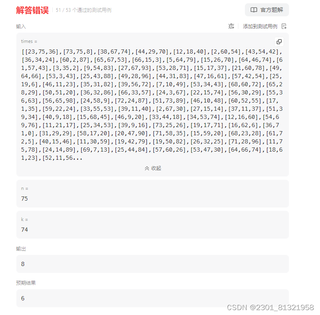
以下是源代码:
python
class Solution:
    def networkDelayTime(self, times: List[List[int]], n: int, k: int) -> int:
        listA=[[] for _ in range(n+1)]
        dictB={(times[i][0],times[i][1]):times[i][2] for i in range(len(times))}#(times[i][0]到times[i][1])的长度是dictB[(times[i][0],times[i][1])]=times[i][2]
        for i in range(len(times)):#listA[i]表示i的邻接
            listA[times[i][0]].append(times[i][1])

        l=[float('inf')]*(n+1)#l[i]是到达i的最短长度
        visited=[False]*(n+1)
        q=deque()
        q.append(k)
        l[0]=0
        l[k]=0 #k到k是0
        while q:#bfs
            top=q.popleft()
            visited[top]=True
            for neighbor in listA[top]:
                if not visited[neighbor]:
                    q.append(neighbor)
                l[neighbor]=min(l[neighbor],l[top]+dictB[(top,neighbor)])#对于top的所有neighbor尝试更新l[neighbor]
        return max(l) if max(l)!=float('inf') else -1 # l更新完了还有inf 则有不可达返回-1
代码思路:
采用BFS遍历这个有向图,同时尝试更新top节点的neighbor的最短路径l[neighbor]=min(l[neighbor],l[top]+dictB[(top,neighbor)]),因为在先前的更新中可以保证l[top]是最小的,所以只需要看l[top]+dictB[(top,neighbor)(先从指定节点k到neighbor,再从top到neighbor)小,还是l[neighbor](从k直接到neighbor或者是上一步的l值)小
当前的疑问:
我觉得代码已经不存在逻辑漏洞,但是应该还有什么边界条件是我没有考虑到的,由于题目给的51号例子的确不太好debug,所以希望得到各位的解答


