引自免费微信小程序:皆我百晓生
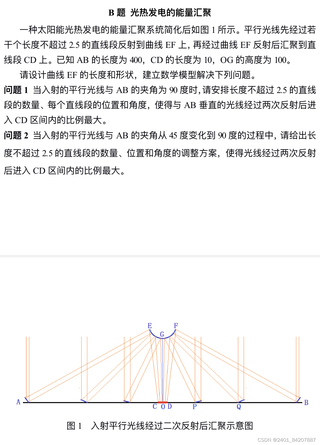
要解决这个问题,我们可以将问题分解成几个部分:首先,我们需要定义直线段和曲线 EF 的数学表示,然后编写函数来计算光线经过两次反射后的路径,接着构建优化模型并使用遗传算法进行求解。
1. 定义直线段和曲线 EF
直线段可以由起点、终点以及法线向量来描述。对于曲线 EF,我们可以选择一个简单但足够复杂的函数来近似它,例如多项式函数。这里我们使用一个二次多项式来表示曲线 EF:
% 曲线 EF 的参数化表示
p = @(t) [100 + 3*t - t.^2; 100 - sqrt(3)*t]; % t 在 0 到 200 范围内
2. 计算光线路径
创建一个函数 calculate_reflection_path 来计算光线经过直线段和曲线 EF 反射后的路径。这个函数接收光线的起始点、方向和直线段的信息作为输入,并返回最终落点。
function [final_point] = calculate_reflection_path(start_point, direction, line_start, line_end, line_angle)
    % 线性反射
    normal = normalize([cos(line_angle); sin(line_angle)]);
    reflection_direction = reflect(direction, normal);
    reflected_point = start_point + reflection_direction * (line_end - start_point)';

    % 折射到曲线 EF
    t = find_intersection(reflected_point, reflection_direction, p, 0, 200);
    if ~isempty(t)
        intersection_point = p(t);
        refracted_direction = reflect(reflection_direction, normal_at(intersection_point, p));
        final_point = intersection_point + refracted_direction * (p(200) - intersection_point)';
    else
        disp('No intersection with curve EF');
        final_point = [];
    end
end

function [t] = find_intersection(point, direction, parametric_func, t_min, t_max)
    % 使用二分搜索找到交点
    % 这里假设光线不会穿过曲线 EF
    % 实际应用可能需要更复杂的算法
    t = binary_search_for_intersection(point, direction, parametric_func, t_min, t_max);
end

function [normal] = normal_at(point, parametric_func)
    % 返回曲线上一点的切线法线
    x = point(1);
    y = point(2);
    dxdt = diff(parametric_func(:,1), 1);
    dydt = diff(parametric_func(:,2), 1);
    normal = [-dydt(x); dxdt(x)];
    normal = normalize(normal);
end
3. 建立优化模型
我们将使用遗传算法来优化直线段的数量、位置和角度。首先,定义适应度函数(fitness function),它根据光线落在 CD 区间内的比例来评估解的质量。
function [fitness] = fitness_function(linear_segments)
    total_refl_count = 0;
    cd_refl_count = 0;

    for i = 1:length(linear_segments)
        line_start = linear_segments(i).start;
        line_end = linear_segments(i).end;
        line_angle = linear_segments(i).angle;

        for j = 1:1000 % 尝试更多次数以提高精度
            rand_dir = randn(2, 1);
            rand_dir = normalize(rand_dir);
            start_point = [400; 0];

            final_point = calculate_reflection_path(start_point, rand_dir, line_start, line_end, line_angle);
            if ~isempty(final_point)
                total_refl_count = total_refl_count + 1;

                if final_point(1) >= 0 && final_point(1) <= 10
                    cd_refl_count = cd_refl_count + 1;
                end
            end
        end
    end

    fitness = cd_refl_count / total_refl_count;
end
4. 遗传算法实现
接下来,实现一个简单的遗传算法来寻找最优解。这只是一个基础版本,实际应用可能需要更复杂的选择、交叉和变异操作。
function [best_solution, best_fitness] = genetic_algorithm(population_size, generations)
    % 初始化种群
    population = initialize_population(population_size);

    % 进行多代优化
    for g = 1:generations
        % 计算适应度值
        fitness_values = zeros(size(population, 1), 1);
        for i = 1:size(population, 1)
            fitness_values(i) = fitness_function(population(i));
        end

        % 选择
        selected_indices = rankdata(-fitness_values, 'stable') <= size(population, 1) / 2;
        selected_population = population(selected_indices, :);

        % 交叉和变异
        new_population = crossover(selected_population);
        new_population = mutate(new_population);

        % 更新种群
        population = new_population;
    end

    % 找出最佳解
    [~, idx] = max(fitness_values);
    best_solution = population(idx, :);
    best_fitness = fitness_values(idx);
end

function [population] = initialize_population(population_size)
    % 创建随机初始种群
    population = struct('start', [], 'end', [], 'angle', []);
    for i = 1:population_size
        num_lines = randi([1, 5]); % 可以调整允许的最大直线段数量
        for j = 1:num_lines
            start_x = randi([0, 400]);
            start_y = 0;
            end_x = min(start_x + randi([0, 25]), 400);
            end_y = 0;
            angle = 2*pi*rand(); % 随机选取角度
            population{i}.start = [start_x; start_y];
            population{i}.end = [end_x; end_y];
            population{i}.angle = angle;
        end
    end
end

function [new_population] = crossover(population)
    % 这里采用单点交叉,实际应用可能需要更复杂的交叉策略
    new_population = population;
    for i = 1:size(population, 1)-1
        cross_idx = randi([i+1, size(population, 1)]);
        split_point = randi([1, length(population{i})]);
        new_population{i}.start(split_point:end) = population{cross_idx}.start(split_point:end);
        new_population{cross_idx}.start(split_point:end) = population{i}.start(split_point:end);
    end
end

function [mutated_population] = mutate(population)
    % 这里简单地对每个个体的某一部分进行变异,实际应用可能需要更复杂的变异策略
    mutated_population = population;
    for i = 1:size(mutated_population, 1)
        mutation_chance = rand();
        if mutation_chance < 0.1
            mutated_population{i}.start = mutated_population{i}.start + 5 * randn(2, 1);
            mutated_population{i}.end = mutated_population{i}.end + 5 * randn(2, 1);
            mutated_population{i}.angle = mutated_population{i}.angle + pi/180 * 10 * randn();
        end
    end
end
5. 运行遗传算法并分析结果
调用遗传算法并输出最佳解。
% 设置参数
population_size = 50; % 种群大小
generations = 100; % 代数

% 解决问题1
[best_solution_1, best_fitness_1] = genetic_algorithm(population_size, generations);
disp(['问题1的最佳解:', num2str(best_fitness_1)])
disp('最佳直线段配置:')
disp(best_solution_1)

% 解决问题2
for alpha = linspace(45, 90, 10) % 检查多个角度
    % 修改入射光线的角度
    parametric_func = @(t) [100 + 3*t - t.^2; 100 - sqrt(3)*t*sind(alpha)];

    [best_solution_2, best_fitness_2] = genetic_algorithm(population_size, generations);
    disp(['角度 ', num2str(alpha), ' 度时,最佳解:', num2str(best_fitness_2)])
    disp('最佳直线段配置:')
    disp(best_solution_2)
end
注意:这个解决方案提供了一个基本框架,实际应用可能需要进一步改进,比如增加光照强度、考虑不同入射角下的权重等。此外,这里的遗传算法是简化的,可能需要调整参数以获得更好的性能。