
C++代码在不同环境下运行结果不一致
问题说明
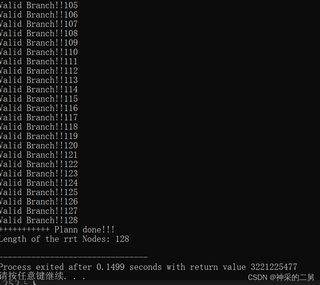
下面是一段RRT算法的C++代码,在VS2022下可以正常运行并输出路径,但是在dev c++下却无法正常输出正常路径,结束时的return value还非常奇怪。附图是dev c++的编译运行结果。
不知道是环境的问题还是代码本身的问题,本人c++水平比较一般。
// RRT Algorithm, Writter: Yuhang Zhou
#include<iostream>
#include<vector>
#include<cmath>
#include<random>
#include<float.h>
#include<time.h>
using namespace std;


class Node {
public:
    vector<float> pos;
    Node* parent;
    Node(vector<float> _pos) {
        pos = _pos;
    };  // init
};

struct Point {
    float x, y;
};

// add two vectors
vector<float> vec_add_sub(vector<float> v1, vector<float> v2, string opt) {
    vector<float> ans;

    for (int i = 0; i < v1.size(); i++) {
        float ele1 = v1[i];
        float ele2 = v2[i];

        if (opt == "+") {
            ans.push_back(ele1 + ele2);
        }
        else {
            ans.push_back(ele1 - ele2);
        }
    }
    return ans;
}


//
vector<float> vec_time(vector<float> v, float n_time) {
    vector<float> ans;

    for (int i = 0; i < v.size(); i++) {
        float ele1 = v[i];

        ans.push_back(ele1 * n_time);
    }
    return ans;
}


class RRT {
private:
    vector<float> start;
    vector<float> end;
    vector<float> x_range, y_range;
    float step_len;
    int iter_max;
    int resolution;

public:
    vector<Node*> node_lst;

    // Init
    RRT(
        vector<float> _start,
        vector<float> _end,
        vector<float> _x_range,
        vector<float> _y_range,
        float _step_len,
        int _iter_max,
        int _resolution) {

        start = _start;
        end = _end;
        x_range = _x_range;
        y_range = _y_range;
        step_len = _step_len;
        iter_max = _iter_max;
        resolution = _resolution;

        Node* start_nd = new Node(_start);
        node_lst.push_back(start_nd);
    }

    vector<vector<float>> linspace(vector<float> _start, vector<float> _end, int n) {
        if (n == 0) return {};
        if (n == 1) return { _start };

        vector<vector<float>> result;
        result.reserve(n);  // n at least

        float dx = (_end[0] - _start[0]) / (n - 1);
        float dy = (_end[1] - _start[1]) / (n - 1);

        for (int i = 0; i < n; ++i) {
            Point p;
            p.x = _start[0] + dx * i;
            p.y = _start[1] + dy * i;
            vector<float> cur_pos = { p.x, p.y };
            result.push_back(cur_pos);
        }

        return result;
    }

    // Collision function
    bool is_branch_valid(vector<float> pnt1, vector<float> pnt2) {
        vector<vector<float>> pnts = linspace(pnt1, pnt2, resolution);
        for (auto pnt : pnts) {
            if (!is_point_valid(pnt)) {
                return false;
            }
        }
        return true;
    }

    bool is_point_valid(vector<float> pnt) {
        vector<vector<float>> obstacles(3, vector<float>(3));
        obstacles = { {20., 15., 1.5}, {35., 15., 1.} };
        for (auto obst : obstacles) {
            vector<float> cur_obst_pos = vector<float>{ obst[0], obst[1] };
            float cur_r = obst[2];
            if (dist(cur_obst_pos, pnt) < cur_r) {
                return false;
            }
        }
        return true;
    }

    vector<float> step_forward(vector<float> par, vector<float> qrand) {
        vector<float> direct_vec = vec_add_sub(qrand, par, "-");
        float length = dist(par, qrand);
        direct_vec = vec_time(direct_vec, 1 / length);
        direct_vec = vec_time(direct_vec, min(dist(qrand, par), step_len));
        return vec_add_sub(direct_vec, par, "+");
    }

    // calc dist
    static float dist(vector<float> pnt1, vector<float> pnt2) {
        float ans = sqrt((pnt1[0] - pnt2[0]) * (pnt1[0] - pnt2[0]) + (pnt1[1] - pnt2[1]) * (pnt1[1] - pnt2[1]));
        return ans;
    }

    // rand point generate
    vector<float> gen_rand_pnt(vector<float> x_range, vector<float> y_range) {
        mt19937 gen(random_device{}());

        uniform_real_distribution<float> x_dist(x_range[0], x_range[1]);
        uniform_real_distribution<float> y_dist(y_range[0], y_range[1]);

        // 生成随机的x和y坐标
        float x = x_dist(gen);
        float y = y_dist(gen);

        return vector<float> {x, y};
    }

    Node* select_best_parent(Node* qrand) {
        float min_dist = 1e7;
        int best_id = -1;
        for (int i = 0; i < node_lst.size(); i++) {
            Node* ndd = node_lst[i];
            vector<float> cur_pos = ndd->pos;
            if (dist(cur_pos, qrand->pos) < min_dist) {
                min_dist = dist(cur_pos, qrand->pos);
                best_id = i;
            }
        }
        return node_lst[best_id];
    }

    void print_ans() {
        vector<vector<float>> pth = extract_path();

        for (auto wp : pth) {
            cout << "[" << wp[0] << ", " << wp[1] << "]" << endl;
        }
    }

    vector<vector<float>> extract_path() {
        Node* goal_nears_par = node_lst[0];
        float goal_nears_dist = 1e7;

        for (int i = 0; i < node_lst.size(); i++) {
            Node* cur_nd = node_lst[i];
            if (dist(cur_nd->pos, end) < goal_nears_dist) {
                goal_nears_dist = dist(cur_nd->pos, end);
                goal_nears_par = cur_nd;
                break;
            }
        }

        vector<vector<float>> ans_path;
        while (goal_nears_par->parent != NULL) {
            ans_path.push_back(goal_nears_par->pos);
            goal_nears_par = goal_nears_par->parent;
        }
        return ans_path;
    }

    void print_vec(vector<float> v) {
        cout << "[" << v[0] << ", " << v[1] << "]" << endl;
    }

    void plan() {
        for (int i = 0; i <= iter_max; i++) {
            vector<float> rand_pos = gen_rand_pnt(x_range, y_range);
            Node* qrand = new Node(rand_pos);
            Node* best_par = select_best_parent(qrand);
            vector<float> qnew_pos = step_forward(best_par->pos, qrand->pos);

            Node* qnew = new Node(qnew_pos);

            if (is_branch_valid(best_par->pos, qnew->pos)) {
                cout << "Valid Branch!!" << i << endl;
                qnew->parent = best_par;
                node_lst.push_back(qnew);

                // reached?
                if ((dist(qnew->pos, end) <= step_len) && (is_branch_valid(qnew->pos, end))) {
                    vector<float> goal_qnew = step_forward(qnew->pos, end);
                    cout << "+++++++++++ Plann done!!!" << endl;
                    // print_ans();
                    return;
                }
            }
        }
    }
};


int main() {
    vector<float> strt = vector<float>{ 2, 10 };
    vector<float> ed = vector<float>{ 45, 10 };
    vector<float> x_border = vector<float>{ 0., 50. };
    vector<float> y_border = vector<float>{ 0., 30. };
    float step_length = 1.5;
    int max_iter = 500, resolutn = 10;

    RRT rrt = RRT(strt, ed, x_border, y_border, step_length, max_iter, resolutn);

    rrt.plan();
    cout << "Length of the rrt Nodes: " << rrt.node_lst.size() << endl;
    rrt.print_ans();
    system("pause");
    return 0;
}


