
为什么代码里面写的at指令连接esp826601s就是失败,但是手动输入aT指令可以连接成功,代码哪里有问题啊
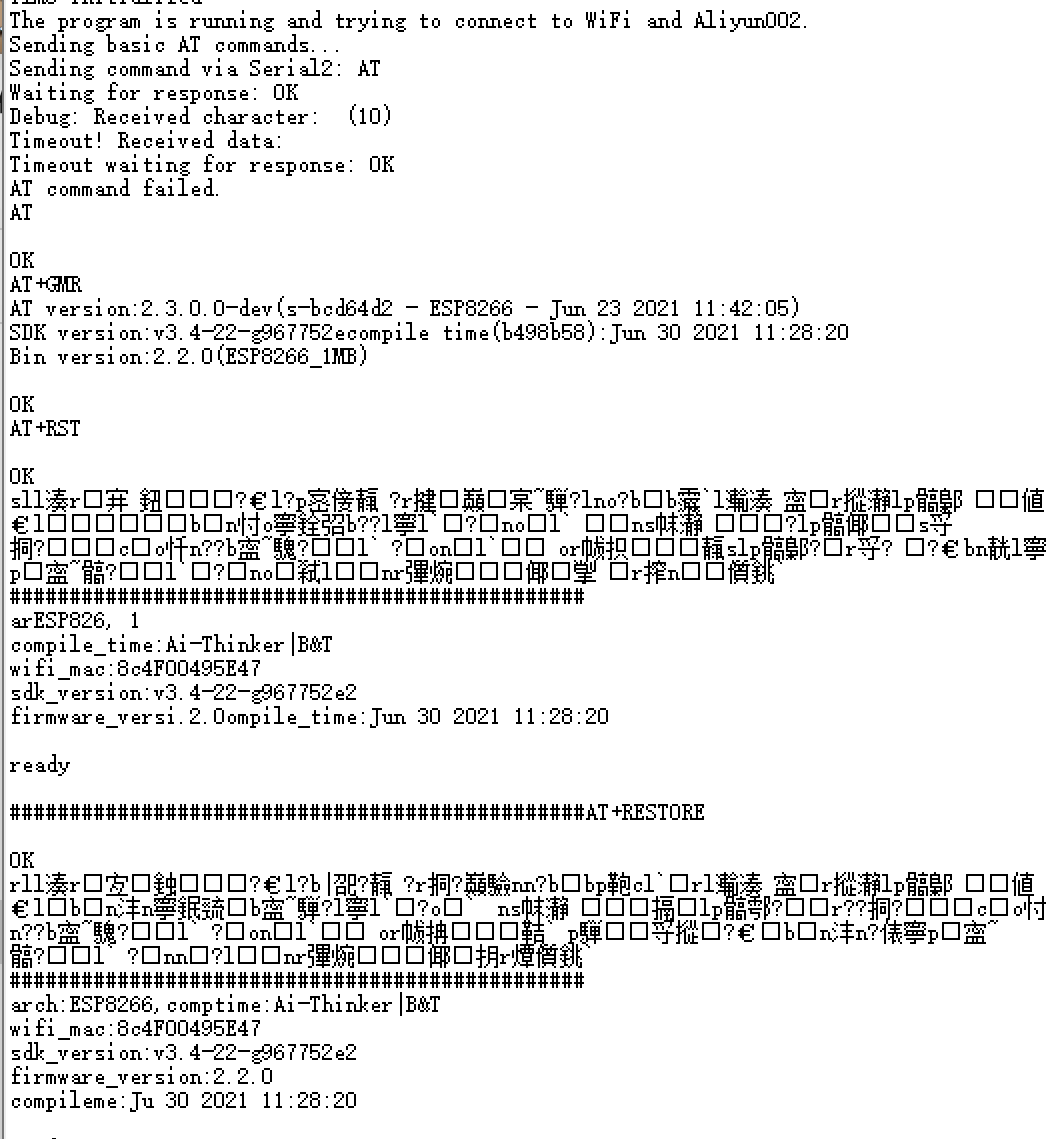
main.c:
#include "delay.h"
#include "sys.h"
#include "Serial.h"
#include "stdio.h"
#include "esp8266.h"
#include "timer.h"

// GPIO??????
void GPIO_Configuration(void);

// ????
int i = 0, j = 0;
char a[] = "LightSwitch";

int main(void)
{
    delay_init();             // ???????
    NVIC_PriorityGroupConfig(NVIC_PriorityGroup_2); // ??NVIC?????2

    // ?????
    Serial1_Init(); // ?????1,?????????????
    Serial1_SendString("Serial1 initialized\r\n");

    Serial2_Init(); // ?????2,???ESP8266??
    Serial1_SendString("Serial2 initialized\r\n");

    TIM3_Int_Init(10 - 1, 7200 - 1);
    Serial1_SendString("TIM3 initialized\r\n");

    Serial1_SendString("The program is running and trying to connect to WiFi and Aliyun002.\r\n");

    // ???ESP8266
    ESP8266_Init();           // ESP8266???

    GPIO_Configuration();

    while (1)
    {
        if (Time_1ms % 10 == 0)
        {
            ESP8266_Received(post_name);
            if (Property_Data[0] == '1')
            {
                PCout(13) = 0; // ??LED
            }
            else if (Property_Data[0] == '0')
            {
                PCout(13) = 1; // ??LED
            }
        }

        // ???2???????????1
        if (Serial2_GetRxFlag())
        {
            char received_data = Serial2_GetRxData();
            Serial1_SendByte(received_data);
        }
    }
}

// GPIO????
void GPIO_Configuration(void)
{
    GPIO_InitTypeDef GPIO_InitStructure;

    RCC_APB2PeriphClockCmd(RCC_APB2Periph_GPIOC, ENABLE);

    // LED -> PC13
    GPIO_InitStructure.GPIO_Pin = GPIO_Pin_13;
    GPIO_InitStructure.GPIO_Speed = GPIO_Speed_50MHz;
    GPIO_InitStructure.GPIO_Mode = GPIO_Mode_Out_PP;
    GPIO_Init(GPIOC, &GPIO_InitStructure);
}


//******************************************************************************************************
esp8266.c:
#include "esp8266.h"
#include "Serial.h"
#include "string.h"
#include "delay.h"
#include <stdio.h>

unsigned char Property_Data[2];

// ESP8266?????
void ESP8266_Init(void)
{
    char wifi_cmd[64];  // WiFi????
    char pub_cmd[128];  // MQTT????

    // 1. ????AT??
    Serial1_SendString("Sending basic AT commands...\r\n");
    if (esp8266_send_cmd("AT", "OK", 50) == 0) {
        Serial1_SendString("AT command successful.\r\n");
        PCout(13) = 0;  // ??LED????
    } else {
        Serial1_SendString("AT command failed.\r\n");
        PCout(13) = 1;  // ??LED????
        return;
    }

    if (esp8266_send_cmd("AT+GMR", "OK", 50) == 0) {
        Serial1_SendString("AT+GMR command successful.\r\n");
    } else {
        Serial1_SendString("AT+GMR command failed.\r\n");
        PCout(13) = 1;  // ??LED????
        return;
    }

    // 2. ?????ESP8266
    Serial1_SendString("Resetting and restoring ESP8266...\r\n");
    if (esp8266_send_cmd("AT+RST", "ready", 200) == 0) {
        Serial1_SendString("AT+RST command successful.\r\n");
        delay_ms(2000); // ??????
    } else {
        Serial1_SendString("AT+RST command failed.\r\n");
        PCout(13) = 1;  // ??LED????
        return;
    }

    if (esp8266_send_cmd("AT+RESTORE", "OK", 100) == 0) {
        Serial1_SendString("AT+RESTORE command successful.\r\n");
    } else {
        Serial1_SendString("AT+RESTORE command failed.\r\n");
        PCout(13) = 1;  // ??LED????
        return;
    }

    // 3. ??WiFi??
    Serial1_SendString("Setting WiFi mode...\r\n");
    if (esp8266_send_cmd("AT+CWMODE=1", "OK", 50) == 0) {
        Serial1_SendString("WiFi mode set successfully.\r\n");
    } else {
        Serial1_SendString("Failed to set WiFi mode!\r\n");
        PCout(13) = 1;  // ??LED????
        return;
    }

    // 4. ??NTP
    Serial1_SendString("Configuring NTP...\r\n");
    if (esp8266_send_cmd("AT+CIPSNTPCFG=1,8,\"ntp1.aliyuncs.com\"", "OK", 100) == 0) {
        Serial1_SendString("NTP configured successfully.\r\n");
    } else {
        Serial1_SendString("Failed to configure NTP!\r\n");
        PCout(13) = 1;  // ??LED????
        return;
    }

    // 5. ??WiFi
    Serial1_SendString("Connecting to WiFi...\r\n");
    sprintf(wifi_cmd, "AT+CWJAP=\"%s\",\"%s\"", WIFI_Name, WIFI_Pass);
    if (esp8266_send_cmd(wifi_cmd, "GOT IP", 500) == 0) {
        Serial1_SendString("Connected to WiFi successfully.\r\n");
    } else {
        Serial1_SendString("Failed to connect to WiFi!\r\n");
        PCout(13) = 1;  // ??LED????
        return;
    }

    // 6. ??MQTT????
    Serial1_SendString("Configuring MQTT user settings...\r\n");
    if (esp8266_send_cmd(MQTT_set, "OK", 100) == 0) {
        Serial1_SendString("MQTT user configuration successful.\r\n");
    } else {
        Serial1_SendString("Failed to set MQTT user configuration!\r\n");
        PCout(13) = 1;  // ??LED????
        return;
    }

    // 7. ??MQTT???ID
    Serial1_SendString("Setting MQTT Client ID...\r\n");
    if (esp8266_send_cmd(MQTT_Client, "OK", 100) == 0) {
        Serial1_SendString("MQTT client ID set successfully.\r\n");
    } else {
        Serial1_SendString("Failed to set MQTT client ID!\r\n");
        PCout(13) = 1;  // ??LED????
        return;
    }

    // 8. ??MQTT???
    Serial1_SendString("Connecting to MQTT server...\r\n");
    if (esp8266_send_cmd(MQTT_Pass, "OK", 300) == 0) {
        Serial1_SendString("Connected to MQTT server successfully.\r\n");
    } else {
        Serial1_SendString("Failed to connect to MQTT server!\r\n");
        PCout(13) = 1;  // ??LED????
        return;
    }

    // 9. ??MQTT??
    Serial1_SendString("Subscribing to MQTT topic...\r\n");
    if (esp8266_send_cmd(MQTT_Sub, "OK", 100) == 0) {
        Serial1_SendString("Subscribed to MQTT topic successfully.\r\n");
    } else {
        Serial1_SendString("Failed to subscribe to MQTT topic!\r\n");
        PCout(13) = 1;  // ??LED????
        return;
    }

    // 10. ??????
    Serial1_SendString("Publishing test data...\r\n");
    sprintf(pub_cmd, "AT+MQTTPUB=0,\"%s\",\"{\\\"params\\\":{\\\"Temperature\\\":10.9}}\",1,0", MQTT_Pub_Topic);
    if (esp8266_send_cmd(pub_cmd, "OK", 100) == 0) {
        Serial1_SendString("Test data published successfully.\r\n");
    } else {
        Serial1_SendString("Failed to publish test data!\r\n");
        PCout(13) = 1;  // ??LED????
    }

    Serial1_SendString("ESP8266 initialization complete!\r\n");
}

// ??AT?????????
u8 esp8266_send_cmd(char *cmd, char *ack, u16 waittime)
{
    u8 res = 0;
    uint16_t timeout = waittime;
    static char response_buffer[256];
    uint16_t response_index = 0;
    char debug_buf[20];  // ???????

    Serial1_SendString("Sending command via Serial2: ");
    Serial1_SendString(cmd);
    Serial1_SendString("\r\n");

    // ??????
    Serial2_ClearRxFlag();

    // ????
    Serial2_SendString(cmd);
    Serial2_SendByte('\r');
    Serial2_SendByte('\n');

    // ??????????????
    delay_ms(200);

    if (ack && waittime)
    {
        Serial1_SendString("Waiting for response: ");
        Serial1_SendString(ack);
        Serial1_SendString("\r\n");

        while (--timeout)
        {
            delay_ms(10);

            // ?????????
            while (Serial2_GetRxFlag())
            {
                char data = Serial2_GetRxData();
                if (response_index < sizeof(response_buffer) - 1)
                {
                    response_buffer[response_index++] = data;

                    // ??????
                    sprintf(debug_buf, "%d", (uint16_t)data);
                    Serial1_SendString("Debug: Received character: ");
                    Serial1_SendByte(data);
                    Serial1_SendString(" (");
                    Serial1_SendString(debug_buf);
                    Serial1_SendString(")\r\n");
                }
            }

            // ???????????
            response_buffer[response_index] = '\0';
            if (strstr(response_buffer, ack) != NULL)
            {
                Serial1_SendString("Command execution successful, response: ");
                Serial1_SendString(response_buffer);
                Serial1_SendString("\r\n");
                return 0; // ??
            }
        }

        // ????
        Serial1_SendString("Timeout! Received data: ");
        if (response_index > 0)
        {
            response_buffer[response_index] = '\0';
            Serial1_SendString(response_buffer);
        }
        else
        {
            Serial1_SendString("No data received");
        }
        Serial1_SendString("\r\n");

        Serial1_SendString("Timeout waiting for response: ");
        Serial1_SendString(ack);
        Serial1_SendString("\r\n");
        res = 1; // ??
    }
    return res;
}

// ????????
u8 *esp8266_check_cmd(char *str)
{
    char *strx = 0;
    static char rx_buf[256];
    static uint16_t rx_index = 0;

    while (Serial2_GetRxFlag())
    {
        rx_buf[rx_index++] = Serial2_GetRxData();
        if (rx_index >= sizeof(rx_buf) - 1)
        {
            rx_index = 0;
        }
    }
    rx_buf[rx_index] = '\0';

    strx = strstr(rx_buf, str);
    return (u8 *)strx;
}

// ?ESP8266??????
void ESP8266_Send(char *property, int Data)
{
    char cmd[128];
    sprintf(cmd, "AT+MQTTPUB=0,\"%s\",\"{\\\"%s\\\":%d}\",1,0\r\n", post, property, Data);
    Serial1_SendString("Sending data via Serial2: ");
    Serial1_SendString(cmd);
    Serial1_SendString("\r\n");
    Serial2_SendString(cmd);
}

// ??ESP8266????
void ESP8266_Received(char *PRO)
{
    unsigned char *ret = 0;
    char *property = 0;
    static char rx_buf[256];
    static uint16_t rx_index = 0;
    int i;

    while (Serial2_GetRxFlag())
    {
        rx_buf[rx_index++] = Serial2_GetRxData();
        if (rx_index >= sizeof(rx_buf) - 1)
        {
            rx_index = 0;
        }
    }
    rx_buf[rx_index] = '\0';

    if (PRO == NULL);
    else
    {
        ret = (unsigned char *)rx_buf;
        if (ret != 0)
        {
            property = strstr((const char *)ret, (const char *)PRO);
            if (property != NULL)
            {
                for (i = 0; i < 2; i++)  // ????
                {
                    Property_Data[i] = *(property + 13 + i);
                }
                if (Property_Data[1] == '}') Property_Data[1] = 0;
            }
        }
    }
    rx_index = 0;
}//******************************************************************************************************


ep8266.h:
#ifndef __ESP8266_H
#define __ESP8266_H

#include "sys.h"

#define post "/k25hksEHYPH/Esp8266_01s_test1/user/Esp8266"
#define post_name "LightSwitch"
#define MQTT_Pub_Topic "/sys/k25hksEHYPH/Esp8266_01s_test1/thing/event/property/post"
#define MQTT_Sub "AT+MQTTSUB=0,\"/k25hksEHYPH/Esp8266_01s_test1/user/get\",1"

// MQTT??
#define MQTT_set    "AT+MQTTUSERCFG=0,1,\"NULL\",\"Esp8266_01s_test1&k25hksEHYPH\",\"3f32fa17fff813571219b33d0108e22d8146debf999584b4950af4fbc5f8ad51\",0,0,\"\""
#define MQTT_Client "AT+MQTTCLIENTID=0,\"k25hksEHYPH.Esp8266_01s_test1|securemode=2\\,signmethod=hmacsha256\\,timestamp=1743766633388|\""
#define MQTT_Pass   "AT+MQTTCONN=0,\"iot-06z00hc4k401f1h.mqtt.iothub.aliyuncs.com\",1883,1"

// WiFi??
#define WIFI_Name "OnePlus 8T"
#define WIFI_Pass "u8ufhfi8"

extern unsigned char Property_Data[];     // ???????

void ESP8266_Init(void);
u8 esp8266_send_cmd(char *cmd, char *ack, u16 waittime);
u8 *esp8266_check_cmd(char *str);
void ESP8266_Send(char *property, int Data);
void ESP8266_Received(char *PRO);

#endif

//*****************************************************************************************************
Serial.c:
#include "stm32f10x.h"
#include "Serial.h"

// 串口1相关变量
volatile uint8_t RxData1;
volatile uint8_t RxFlag1;
volatile uint8_t RxBuffer1[256];
volatile uint16_t RxIndex1 = 0;

// 串口2相关变量
volatile uint8_t RxData2;
volatile uint8_t RxFlag2;
volatile uint8_t RxBuffer2[256];
volatile uint16_t RxIndex2 = 0;

// 串口1初始化函数
void Serial1_Init(void)
{
    GPIO_InitTypeDef GPIO_InitStruct;
    USART_InitTypeDef USART_InitStruct;
    NVIC_InitTypeDef NVIC_InitStruct;

    // 使能时钟
    RCC_APB2PeriphClockCmd(RCC_APB2Periph_GPIOA |
                           RCC_APB2Periph_USART1 |
                           RCC_APB2Periph_AFIO, ENABLE);

    // GPIO配置
    // TX (PA9) 复用推挽输出
    GPIO_InitStruct.GPIO_Pin = GPIO_Pin_9;
    GPIO_InitStruct.GPIO_Mode = GPIO_Mode_AF_PP;
    GPIO_InitStruct.GPIO_Speed = GPIO_Speed_50MHz;
    GPIO_Init(GPIOA, &GPIO_InitStruct);

    // RX (PA10) 浮空输入
    GPIO_InitStruct.GPIO_Pin = GPIO_Pin_10;
    GPIO_InitStruct.GPIO_Mode = GPIO_Mode_IN_FLOATING;
    GPIO_Init(GPIOA, &GPIO_InitStruct);

    // USART参数配置
    USART_InitStruct.USART_BaudRate = 115200;
    USART_InitStruct.USART_WordLength = USART_WordLength_8b;
    USART_InitStruct.USART_StopBits = USART_StopBits_1;
    USART_InitStruct.USART_Parity = USART_Parity_No;
    USART_InitStruct.USART_Mode = USART_Mode_Tx | USART_Mode_Rx;
    USART_InitStruct.USART_HardwareFlowControl = USART_HardwareFlowControl_None;
    USART_Init(USART1, &USART_InitStruct);

    // 中断配置
    USART_ITConfig(USART1, USART_IT_RXNE, ENABLE);

    NVIC_InitStruct.NVIC_IRQChannel = USART1_IRQn;
    NVIC_InitStruct.NVIC_IRQChannelPreemptionPriority = 1;
    NVIC_InitStruct.NVIC_IRQChannelSubPriority = 1;
    NVIC_InitStruct.NVIC_IRQChannelCmd = ENABLE;
    NVIC_Init(&NVIC_InitStruct);

    // 使能串口
    USART_Cmd(USART1, ENABLE);
}

// 串口2初始化函数
void Serial2_Init(void)
{
    GPIO_InitTypeDef GPIO_InitStruct;
    USART_InitTypeDef USART_InitStruct;
    NVIC_InitTypeDef NVIC_InitStruct;

    // 使能时钟
    RCC_APB1PeriphClockCmd(RCC_APB1Periph_USART2, ENABLE);
    RCC_APB2PeriphClockCmd(RCC_APB2Periph_GPIOA, ENABLE);

    // GPIO配置
    // TX (PA2) 复用推挽输出
    GPIO_InitStruct.GPIO_Pin = GPIO_Pin_2;
    GPIO_InitStruct.GPIO_Mode = GPIO_Mode_AF_PP;
    GPIO_InitStruct.GPIO_Speed = GPIO_Speed_50MHz;
    GPIO_Init(GPIOA, &GPIO_InitStruct);

    // RX (PA3) 浮空输入
    GPIO_InitStruct.GPIO_Pin = GPIO_Pin_3;
    GPIO_InitStruct.GPIO_Mode = GPIO_Mode_IN_FLOATING;
    GPIO_Init(GPIOA, &GPIO_InitStruct);

    // USART参数配置
    USART_InitStruct.USART_BaudRate = 115200;
    USART_InitStruct.USART_WordLength = USART_WordLength_8b;
    USART_InitStruct.USART_StopBits = USART_StopBits_1;
    USART_InitStruct.USART_Parity = USART_Parity_No;
    USART_InitStruct.USART_Mode = USART_Mode_Tx | USART_Mode_Rx;
    USART_InitStruct.USART_HardwareFlowControl = USART_HardwareFlowControl_None;
    USART_Init(USART2, &USART_InitStruct);

    // 中断配置
    USART_ITConfig(USART2, USART_IT_RXNE, ENABLE);

    NVIC_InitStruct.NVIC_IRQChannel = USART2_IRQn;
    NVIC_InitStruct.NVIC_IRQChannelPreemptionPriority = 2;
    NVIC_InitStruct.NVIC_IRQChannelSubPriority = 2;
    NVIC_InitStruct.NVIC_IRQChannelCmd = ENABLE;
    NVIC_Init(&NVIC_InitStruct);

    // 使能串口
    USART_Cmd(USART2, ENABLE);
}

// 串口1中断服务函数
void USART1_IRQHandler(void)
{
    if (USART_GetITStatus(USART1, USART_IT_RXNE))
    {
        RxData1 = USART_ReceiveData(USART1);
        RxBuffer1[RxIndex1++] = RxData1;
        if (RxIndex1 >= sizeof(RxBuffer1))
        {
            RxIndex1 = 0;
        }
        RxFlag1 = 1;

        // 将接收到的数据发送到串口2
        Serial2_SendByte(RxData1);
        USART_ClearITPendingBit(USART1, USART_IT_RXNE);
    }
}

// 串口2中断服务函数
void USART2_IRQHandler(void)
{
    if (USART_GetITStatus(USART2, USART_IT_RXNE))
    {
        RxData2 = USART_ReceiveData(USART2);
        RxBuffer2[RxIndex2++] = RxData2;
        if (RxIndex2 >= sizeof(RxBuffer2))
        {
            RxIndex2 = 0;
        }
        RxFlag2 = 1;
        USART_ClearITPendingBit(USART2, USART_IT_RXNE);
    }
}

// 串口1发送单字节函数
void Serial1_SendByte(uint8_t Byte)
{
    while (USART_GetFlagStatus(USART1, USART_FLAG_TXE) == RESET);
    USART_SendData(USART1, Byte);
}

// 串口2发送单字节函数
void Serial2_SendByte(uint8_t Byte)
{
    while (USART_GetFlagStatus(USART2, USART_FLAG_TXE) == RESET);
    USART_SendData(USART2, Byte);
}

// 串口1发送字符串函数
void Serial1_SendString(char *String)
{
    while (*String)
    {
        Serial1_SendByte(*String++);
    }
}

// 串口2发送字符串函数
void Serial2_SendString(char *String)
{
    while (*String)
    {
        Serial2_SendByte(*String++);
    }
}

// 串口1获取接收标志函数
uint8_t Serial1_GetRxFlag(void)
{
    if (RxFlag1)
    {
        RxFlag1 = 0;
        return 1;
    }
    return 0;
}

// 串口2获取接收标志函数
uint8_t Serial2_GetRxFlag(void)
{
    if (RxFlag2)
    {
        RxFlag2 = 0;
        return 1;
    }
    return 0;
}

// 串口1获取接收数据函数
uint8_t Serial1_GetRxData(void)
{
    if (RxIndex1 > 0)
    {
        return RxBuffer1[--RxIndex1];
    }
    return 0;
}

// 串口2获取接收数据函数
uint8_t Serial2_GetRxData(void)
{
    if (RxIndex2 > 0)
    {
        return RxBuffer2[--RxIndex2];
    }
    return 0;
}

// 串口1清除接收标志函数
void Serial1_ClearRxFlag(void)
{
    RxFlag1 = 0;
    RxIndex1 = 0;
}

// 串口2清除接收标志函数
void Serial2_ClearRxFlag(void)
{
    RxFlag2 = 0;
    RxIndex2 = 0;
}


//***************************************************************************************************

serial.h:

#ifndef __SERIAL_H
#define __SERIAL_H

#include "stm32f10x.h"

// ??1????
extern volatile uint8_t RxData1;
extern volatile uint8_t RxFlag1;
extern volatile uint8_t RxBuffer1[256];
extern volatile uint16_t RxIndex1;

// ??2????
extern volatile uint8_t RxData2;
extern volatile uint8_t RxFlag2;
extern volatile uint8_t RxBuffer2[256];
extern volatile uint16_t RxIndex2;

// ????
void Serial1_Init(void);
void Serial2_Init(void);

void USART1_IRQHandler(void);
void USART2_IRQHandler(void);

void Serial1_SendByte(uint8_t Byte);
void Serial2_SendByte(uint8_t Byte);
void Serial1_SendString(char *String);
void Serial2_SendString(char *String);

uint8_t Serial1_GetRxFlag(void);
uint8_t Serial2_GetRxFlag(void);
uint8_t Serial1_GetRxData(void);
uint8_t Serial2_GetRxData(void);

void Serial1_ClearRxFlag(void);
void Serial2_ClearRxFlag(void);

#endif


