
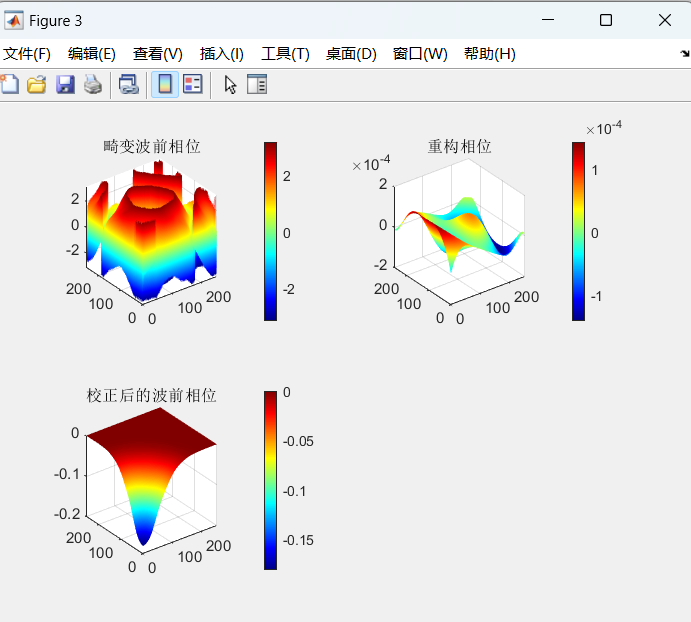
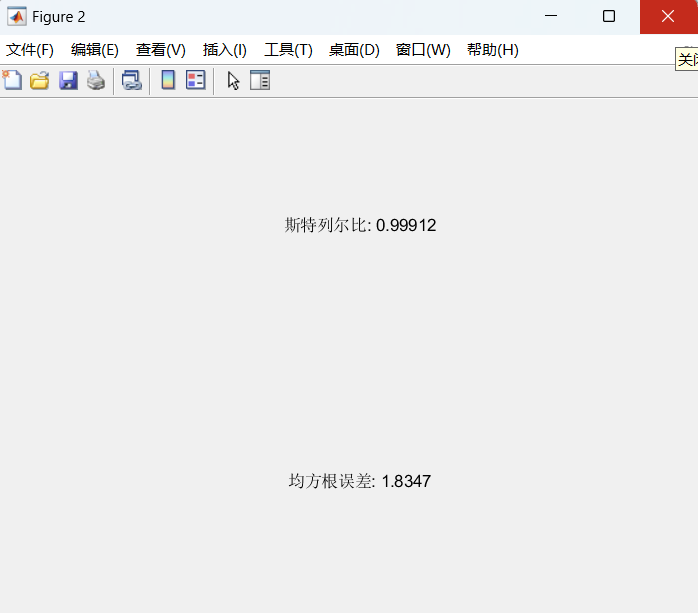
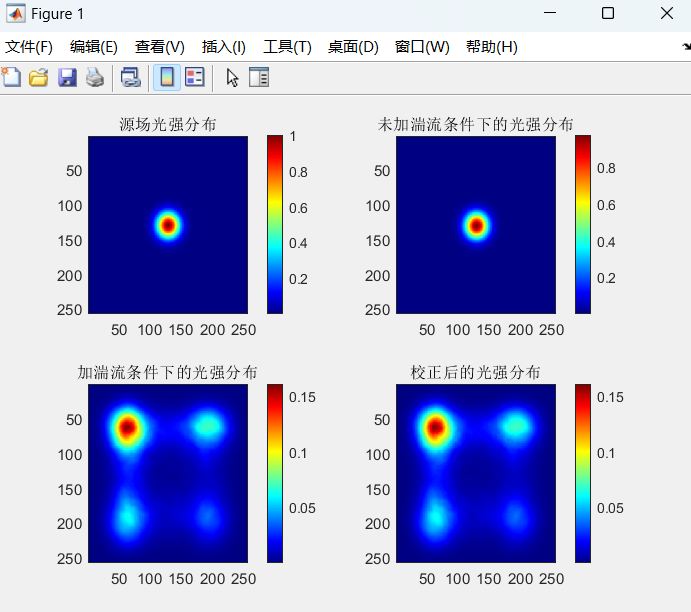
请根据图片,分析一下我这个自适应光学系统是否搭建成功?
```bash
clc
clear
close all
%%参数设置
z = 3000; % 传输距离 (单位: 米)
N = 256; % 采样点数目
w0 = 0.1; % 束腰半径 (单位: 米)
Cn2 = 1e-15; % 湍流结构常数
lambda = 1550*10.^-9; % 波长 (单位: 米)
L = 1; % 输入屏尺寸 (单位: 米)
L2 = 1; % 相位屏尺寸 (单位: 米)
bushu = 25; % 相位屏数量
noise_level = 0.1; % 噪声水平调节因子
N_sub = 16; % 每个微透镜对应的子孔径像素数
f_lens = 0.04; % 微透镜焦距 (单位: 米)
 % 子孔径掩膜
[x, y] = meshgrid(1:N_sub, 1:N_sub);
center = (N_sub + 1) / 2;
r = sqrt((x - center).^2 + (y - center).^2);
radius = N_sub / 2;
aperture_mask = double(r <= radius);
num_modes = 36; % 使用的 Zernike 模式数
nLayers = 6; % 示例促动器层数
sigma = 1.5; % 示例高斯函数标准差
pitch = 0.05; % 示例促动器间距
mirrorSize = [120, 120]; % 示例变形镜尺寸
% SPGD算法参数
step_size = 0.05; % 步长
max_iterations = 200; % 最大迭代次数
decay = 0.98;
min_step_size = 0.01;
% 初始生成大气湍流相位屏和光场
[I0, I1, I3, UT, phase3] = generate_von_karman_phase_screen(z, N, w0, Cn2, lambda, L, L2, bushu, noise_level);
[slope_x, slope_y] = shack_hartmann_measurement(I1, I3, N_sub, L,N, f_lens,aperture_mask);
[phase_reconstruction, G,Z_coeff] = zernike_wavefront_reconstruction(N, L, N_sub, slope_x, slope_y,  num_modes,aperture_mask);
[B,V]=control(slope_x,slope_y,G,num_modes,nLayers,sigma,pitch,mirrorSize);
[corrected_I,phase_corrected] = correction( phase_reconstruction,UT,V,mirrorSize,nLayers, pitch,sigma);
[actuator_pos, num_Actuators] = generateHexActuators(nLayers, pitch);
% SPGD算法迭代
for iteration = 1:max_iterations
    % 计算性能指标
   strehl_ratio = calculate_strehl_ratio(I1, phase_corrected);
    rmse = calculate_rmse(phase3, phase_corrected);
    % 检查是否满足条
    if strehl_ratio > 0.905 && rmse < 1.65
        disp('优化目标已达到,停止迭代。');
        break;
    end

    % 生成随机扰动
    delta_V = randn(num_Actuators, 1);
    % 正向扰动
    V_plus = V + step_size * delta_V;
    [corrected_I_plus,phase_corrected_plus] = correction( phase_reconstruction,UT,V_plus,mirrorSize,nLayers, pitch,sigma);
    strehl_ratio_plus = calculate_strehl_ratio(I1, corrected_I_plus);
    rmse_plus = calculate_rmse(phase3, phase_corrected_plus);
    % 负向扰动
    V_minus = V - step_size * delta_V;
   [corrected_I_minus,phase_corrected_minus] = correction( phase_reconstruction,UT,V_minus,mirrorSize,nLayers, pitch,sigma);
   strehl_ratio_minus = calculate_strehl_ratio(I1, corrected_I_minus);
    rmse_minus = calculate_rmse(phase3, phase_corrected_minus);
    % 计算梯度
    gradient_strehl = (strehl_ratio_plus - strehl_ratio_minus) / (2 * step_size);
    gradient_rmse = (rmse_plus - rmse_minus) / (2 * step_size);
    % 综合目标函数的权重
    alpha = 0.5; % Strehl 比的权重
    beta = 0.5;  % RMSE 的权重

    % 更新系数矩阵
    V = V + step_size * (alpha * gradient_strehl - beta * gradient_rmse);
   [corrected_I,phase_corrected] = correction( phase_reconstruction,UT,V,mirrorSize,nLayers, pitch,sigma);
    % 显示当前迭代结果
    disp(['Iteration ', num2str(iteration), ': RMSE = ', num2str(rmse), ', Strehl Ratio = ', num2str(strehl_ratio)]);
% 步长更新策略
    % 1. 基于迭代次数的衰减
    if mod(iteration, 10) == 0
        step_size = max(step_size * decay, min_step_size);
    end
    % 检查是否达到最大迭代次数
    if iteration >= max_iterations
        disp('达到最大迭代次数,停止优化。');
        break;
    end
end
visualize_results(I0, I1, I3, corrected_I, phase3,phase_reconstruction, phase_corrected, strehl_ratio, rmse);


function[I0, I1, I3, UT, phase3] = generate_von_karman_phase_screen(z, N, w0, Cn2, lambda, L, L2, bushu, noise_level)
    % 计算基本参数
    k = 2 * pi / lambda; % 波数
    delta = L / N; % 空间采样间隔
    x = (-N/2:N/2-1) * delta;
    y = x;
    [X, Y] = meshgrid(x, y);
    [~, r] = cart2pol(X, Y);

    % 高斯光束参数
    z1 = 0; % 束腰位置
    n_i = 1.0; % 背景空间折射率
    k0 = k * n_i; % 背景空间的波数
    ZR = k0 * w0^2 / 2; % 瑞利距离
    w = w0 * sqrt(1 + (z1 / ZR)^2); % 传播到 z1 处的束宽
    R = ZR * (z1 / ZR + ZR / z1); % 等相位面曲率半径
    Phi = atan(z1 / ZR); % 相位因子

    % 高斯光束电场表达式
    E0 = (1 / (1 + 1i * z1 / ZR)) .* exp(-(r.^2 / w0^2) ./ (1 + 1i * z1 / ZR)) .* exp(1i * k0 * z1);

    % 源场光场
    I0 = abs(E0).^2;

    % 未加湍流条件下的传输
    x1 = linspace(-L / 2, L / 2, N).*N; % 频域坐标
    y1 = linspace(-L / 2, L / 2, N).*N;
    [kethi, nenta] = meshgrid(x1, y1);
    U0 = E0;
    H = exp(1i * k * z * (1 - (lambda^2) * (kethi.^2 + nenta.^2) / 2)); % 传递函数
    G0 = fftshift(fft2(U0)); % 衍射面上光场的傅里叶变换
    G = G0 .* H; % 光场的频谱与传递函数相乘
    U = ifft2(G); % 在观察屏上的光场分布
    I1 = U .* conj(U); % 在观察屏上的光强分布

    % 加湍流条件下的传输
    deltz = z / bushu; % 相位屏间距
    l0 = 0.01; % 内尺度
    L0 = 10; % 外尺度
    r0 = (0.4229 * (k^2) * Cn2 * deltz)^(-3/5); % 大气相干长度
    subh = 8; % 次谐波次数
    delta1 = L2 / N; % 相位屏采样间隔
    fx = (-N/2:N/2-1) * (1 / (N * delta1)); % 横向频率
    [kx, ky] = meshgrid(2 * pi * fx); % 生成网格坐标矩阵
    [~, ka] = cart2pol(kx, ky); % 转换为极坐标
    km = 5.92 / l0; % 内尺度对应的波数
    k0 = 2 * pi / L0; % 外尺度对应的波数
    PSD_phi = 0.033 * Cn2 * exp(-(ka / km).^2) ./ (ka.^2 + k0.^2).^(11/6); % 冯卡门谱
    PSD_phi(N/2+1, N/2+1) = 0; % 避免除以零
    cn = 2 * pi * (k^2) * deltz * PSD_phi * (2 * pi * (1 / (N * delta1)))^2; % 相位扰动的幅度
    UT = E0;
    for l = 1:bushu
        % 生成高频相位屏
        phz_hi = ift2(noise_level * (randn(N) + 1i * randn(N)) .* sqrt(cn), 1);
        phz_hi = real(phz_hi);

        % 低频补偿
        phz_lo = zeros(size(phz_hi));
        for p = 1:subh
            del_fp = 1 / (3^p * L2);
            fx1 = (-1:1) * del_fp;
            [kx1, ky1] = meshgrid(2 * pi * fx1);
            [th1, k1] = cart2pol(kx1, ky1);
            PSD_phi1 = 0.033 * Cn2 * exp(-(k1 / km).^2) ./ (k1.^2 + k0.^2).^(11/6);
            PSD_phi1(2, 2) = 0;
            cn1 = 2 * pi * k^2 * deltz * PSD_phi1 * (2 * pi * del_fp)^2;
            cn1 = noise_level * (randn(3) + 1i * randn(3)) .* sqrt(cn1);
            SH = zeros(N);
            for ii = 1:9
                SH = SH + cn1(ii) * exp(1i * (kx1(ii) * X + ky1(ii) * Y));
            end
            phz_lo = phz_lo + SH;
        end
        phz_lo = real(phz_lo) - mean(real(phz_lo(:)));
        phz = phz_hi + phz_lo;
       figure (5)
       pcolor(kx,ky,phz);
       colormap("jet")
       axis on;
       shading interp;
       axis square;  %输出正方形图像
       colorbar;
       title("低频补偿后的大气湍流随机相位屏");

       % 判断是否是第一次循环,第一次循环时不叠加随机相位屏
        if l == 1
            G1 = fftshift(fft2(UT));
        else
            UT = UT .* exp(1i * phz);
            G1 = fftshift(fft2(UT));
        end

        % 光场传播
        x2 = linspace(-L/2, L/2, N) * N;
        y2 = linspace(-L/2, L/2, N) * N;
        [kethi2, nenta2] = meshgrid(x2, y2);
        H = exp(1i * k * deltz * (1 - (lambda^2)*(kethi2.^2 + nenta2.^2)/2));
        G1 = G1 .* H;
        UT = ifft2(G1);

        % 可视化中间结果(可选)
        if l ~= bushu
            I2 = UT .* conj(UT);
            figure(3);
            pcolor(x, y, I2);
            nu = l-1;
            title("经"+nu+"次大气湍流传输后的光场");
            colormap("jet");
            colorbar;
            axis on;
            shading interp;
            axis square;  %输出正方形图像
            axis image;
            xlabel('{\itx}(m)');
            ylabel('{\ity}(m)');
        end
    end

    % 最终光强分布
    I3 = UT .* conj(UT);
    phase3 = angle(UT) ;
end
function g = ift2(G, delta_f)
% function g = ift2(G, delta_f)
N = size(G, 1);
g = ifftshift(ifft2(ifftshift(G)))*(N*delta_f)^2;
end

function [slope_x, slope_y] = shack_hartmann_measurement(I1, I3, N_sub, L, N, f_lens, aperture_mask)

    % 获取光强分布的尺寸
    [N, ~] = size(I1);

    % 计算子孔径的数量
    num_sub_x = floor(N / N_sub);
    num_sub_y = floor(N / N_sub);

    % 初始化质心偏移量矩阵
    centroid_offset_x = zeros(num_sub_y, num_sub_x);
    centroid_offset_y = zeros(num_sub_y, num_sub_x);

    % 遍历每个子孔径计算质心偏移
    for i = 1:num_sub_y
        for j = 1:num_sub_x
            % 提取当前子孔径的光强分布
            start_row = (i - 1) * N_sub + 1;
            end_row = start_row + N_sub - 1;
            start_col = (j - 1) * N_sub + 1;
            end_col = start_col + N_sub - 1;

            % 应用孔径掩码
            sub_I1 = I1(start_row:end_row, start_col:end_col) .* aperture_mask;
            sub_I3 = I3(start_row:end_row, start_col:end_col) .* aperture_mask;

            % 计算质心并转换为物理单位
            [centroid_x1, centroid_y1] = calculate_centroid(sub_I1);
            [centroid_x3, centroid_y3] = calculate_centroid(sub_I3);

            centroid_offset_x(i, j) = (centroid_x3 - centroid_x1) * (L/N);
            centroid_offset_y(i, j) = (centroid_y3 - centroid_y1) * (L/N);
        end
    end

    % 计算波前斜率
    slope_x = centroid_offset_x/ f_lens;
    slope_y = centroid_offset_y / f_lens;

end


function [centroid_x, centroid_y] = calculate_centroid(I)
    % 计算光斑质心
    [rows, cols] = size(I);
    [X, Y] = meshgrid(1:cols, 1:rows);
    total_intensity = sum(I(:));
    centroid_x = sum(sum(I .* X)) / total_intensity;
    centroid_y = sum(sum(I .* Y)) / total_intensity;
end

function [phase_reconstruction, G,Z_coeff] = zernike_wavefront_reconstruction(N, L, N_sub, slope_x, slope_y,  num_modes,aperture_mask)
        del=L/N;
        x1 = (-N/2: N/2-1)*del ;
        y1=x1;
        %生成全局坐标系
         [X, Y] = meshgrid(x1,y1);
         rho = sqrt((X).^2 + (Y ).^2)/sqrt((L/2)^2 + (L/2)^2);
         theta = atan2(Y , X );
         %生成子孔径坐标系
         x2= (-N_sub/2:N_sub/2-1)*del;
         y2=x2;
         [X_sub, Y_sub] = meshgrid(x2, y2);
         rho12 = sqrt((X_sub).^2 + (Y_sub).^2)/sqrt((N_sub*del/2)^2 + (N_sub*del/2)^2);
         theta12 = atan2(Y_sub , X_sub );
        % 生成Noll顺序的Zernike模式索引
        modes = generate_noll_modes(num_modes);

        % 获取子孔径数量并初始化G矩阵
        num_sub_x = floor(N / N_sub);
        num_sub_y = floor(N / N_sub);
        K = num_sub_y * num_sub_x;
        G = zeros(2*K, num_modes);

        % 构建G矩阵
        for i = 1:num_sub_y
            for j = 1:num_sub_x
                k = (i-1)*num_sub_x + j;
                s_sub_x = L / num_sub_x;       % 子孔径物理宽度
                s_sub_y = L / num_sub_y;       % 子孔径物理高度

                z = s_sub_x*s_sub_y;
                for m_idx = 1:num_modes

                    n = modes(m_idx, 1);
                    m = modes(m_idx, 2);
                     Z = zernike_poly(n, m, rho12, theta12);
                    dZdx = gradient(Z, del, 1);  % x方向梯度(列方向)
                    dZdy = gradient(Z, del, 2);  % y方向梯度(行方向)
                   dx = s_sub_x/N_sub;
                   dy = s_sub_y/N_sub;

                  F_x=(sum(sum(dZdx .* aperture_mask) )* dx * dy)/z;
                  F_y=(sum(sum(dZdy .* aperture_mask) )* dx  * dy)/z;
                     G(2*k-1, m_idx) =F_x;
                     G(2*k, m_idx) =F_y;
                end
            end
        end
        %disp(G);
        %disp(Z);

        % 构建斜率向量并求解系数
        s = [slope_x(:); slope_y(:)];
       alpha = 1e-4; % 正则化参数
        Z_coeff = (G'*G + alpha*eye(num_modes)) \ (G'*s);

    % 生成Noll模式
    modes = generate_noll_modes(num_modes);

    % 初始化相位畸变
    phase_reconstruction = zeros(size(X));

    % 计算Zernike多项式叠加
    for m_idx = 1:num_modes
        n = modes(m_idx, 1);
        m = modes(m_idx, 2);
        Z = zernike_poly(n, m, rho, theta);
        phase_reconstruction = phase_reconstruction + Z_coeff(m_idx) * Z;
    end
end

function modes = generate_noll_modes(M)
    modes = zeros(M, 2);
    idx = 1;
    n = 0;

    while idx <= M
        m_candidates = -n:2:n;
        valid_m = m_candidates(mod(n + abs(m_candidates), 2) == 0);
        valid_m = unique(valid_m);

        positive_m = valid_m(valid_m > 0);
        zero_m = valid_m(valid_m == 0);
        negative_m = valid_m(valid_m < 0);

        sorted_m = [];
        if ~isempty(positive_m)
            sorted_m = [sort(positive_m, 'descend')];  % 正m降序
        end
        if ~isempty(zero_m)
            sorted_m = [sorted_m, 0];
        end
        if ~isempty(negative_m)
            sorted_m = [sorted_m, sort(negative_m, 'descend')];  % 负m降序(绝对值升序)
        end

        for i = 1:length(sorted_m)
            if idx > M
                break;
            end
            modes(idx, :) = [n, sorted_m(i)];
            idx = idx + 1;
        end

        n = n + 1;
    end
end

function Rnm = radial_polynomial(n, m, rho)
    % 验证输入参数,确保n - m为偶数,否则返回全零数组
    if mod(n - m, 2) ~= 0
        Rnm = zeros(size(rho));
        return;
    end

    % 计算径向多项式Rnm
    Rnm = zeros(size(rho));
    for k = 0:(n - abs(m)) / 2
        % 根据公式计算径向函数Rnm的每一项并累加
        Rnm = Rnm + (-1)^k * factorial(n - k) / ...
            (factorial(k) * factorial((n + m) / 2 - k) * factorial((n - m) / 2 - k)) * rho.^(n - 2 * k);
    end
end

function Znm = zernike_poly(n, m, rho, theta)
    % 计算径向多项式
    Rnm = radial_polynomial(n, m, rho);

    % 根据角向阶数m的值,按照Zernike多项式定义计算Znm
    if m == 0
        Znm = sqrt(n + 1) * radial_polynomial(n, 0, rho);
    elseif m > 0
        Znm = sqrt(2 * (n + 1)) * Rnm .* cos(m * theta);
    else
        Znm = sqrt(2 * (n + 1)) * Rnm .* sin(m * theta);
    end

    % 应用孔径掩膜(在归一化坐标中),将rho大于1的位置设为0
    %   Znm(rho > 1) = 0;
end

function [B,V]=control(slope_x,slope_y,G,num_modes,nLayers,sigma,pitch,mirrorSize)
         S=[slope_x(:);slope_y(:)];
         [actuator_pos, num_Actuators] = generateHexActuators(nLayers, pitch);
         mirrorPhysicalSize = [mirrorSize(1)*pitch, mirrorSize(2)*pitch];
         [X, Y] = meshgrid(1:mirrorPhysicalSize(1),1:mirrorPhysicalSize(2));
          B=zeros(num_modes,num_Actuators);

          for i = 1:size(actuator_pos, 1)
          gaussian = exp(-((X - actuator_pos(i, 1)).^2 + (Y - actuator_pos(i, 2)).^2) / (2 * sigma^2));
          B(:,i) =  reshape(gaussian, [], 1);
          end
          D=G*B;
          lambda = 1e-4; % 正则化参数
          V = -(D' * D + lambda * eye(size(D, 2))) \ (D' * S);
end

function [actuator_pos, num_Actuators] = generateHexActuators(nLayers, pitch)

    actuator_pos = [];
    num_Actuators = 0;

    for k = 0:nLayers
        for q = -k:k
            r_min = max(-k, -q - k);
            r_max = min(k, -q + k);
            for r = r_min:r_max
                s = -q - r;
                if max(abs([q, r, s])) == k
                    x = pitch * (q + 0.5 * r);
                    y = pitch * (sqrt(3)/2) * r;
                    actuator_pos = [actuator_pos; x, y];
                    num_Actuators = num_Actuators + 1;
                end
            end
        end
    end

end
function [corrected_I,phase_corrected] = correction( phase_reconstruction,UT,V,mirrorSize,nLayers, pitch,sigma)
         [actuator_pos, ~] = generateHexActuators(nLayers, pitch);
          mirrorPhysicalSize = [mirrorSize(1)*pitch, mirrorSize(2)*pitch];
          phase11=zeros(mirrorPhysicalSize);
          [X, Y] = meshgrid(1:mirrorPhysicalSize(1),1:mirrorPhysicalSize(2));
          for i = 1:size(actuator_pos, 1)
              xi = actuator_pos(i, 1);
              yi = actuator_pos(i, 2);
             dist_sq = (X - xi).^2 + (Y - yi).^2;
             phase11 = phase11 + V(i) * exp(-dist_sq / (2 * sigma^2));
          end
          phase_corrected=imresize(phase11,[256,256]);
    UT_corrected = UT.* exp(1i * phase_corrected);
    corrected_I = UT_corrected .* conj(UT_corrected);
    phase_corrected = phase_reconstruction + phase_corrected;
end


function strehl_ratio = calculate_strehl_ratio(I1,phase_corrected)
     phase1=angle(I1);
    % 计算理想PSF(无像差)
    ideal_psf = abs(fft2(ones(size(phase1)))).^2;
    ideal_peak = max(ideal_psf(:));

    % 计算校正后PSF
    corrected_psf = abs(fft2(exp(1i*phase_corrected))).^2;
    corrected_peak = max(corrected_psf(:));

    strehl_ratio = corrected_peak / ideal_peak;
end

function rmse = calculate_rmse(phase3, phase_corrected)
    % 计算包裹后的相位差
    phase_diff = phase3 - phase_corrected;
    phase_diff_wrapped = angle(exp(1i * phase_diff)); % 包裹到[-pi, pi)
    rmse = sqrt(mean(phase_diff_wrapped(:).^2));
end

function visualize_results(I0, I1, I3, corrected_I, phase3,phase_reconstruction, phase_corrected, strehl_ratio, rmse)

    figure(1);

    % 显示未加湍流条件下的光强分布
    subplot(2,2,1);
    imagesc(I0);
    title('源场光强分布');
    colorbar;
    colormap("jet");

    % 显示未加湍流条件下的光强分布
    subplot(2,2,2);
    imagesc(I1);
    title('未加湍流条件下的光强分布');
    colorbar;
    colormap("jet");

    % 显示加湍流条件下的光强分布
    subplot(2,2,3);
    imagesc(I3);
    title('加湍流条件下的光强分布');
    colorbar;
    colormap("jet");

    % 显示校正后的光强分布
    subplot(2,2,4);
    imagesc(corrected_I);
    title('校正后的光强分布');
    colorbar;
    colormap("jet")

    % 创建一个新的图用于显示斯特列尔比和均方根误差
    figure(2);

    % 显示斯特列尔比和均方根误差
    text(0.5, 0.8, ['斯特列尔比: ', num2str(strehl_ratio)], 'HorizontalAlignment', 'center');
    text(0.5, 0.2, ['均方根误差: ', num2str(rmse)], 'HorizontalAlignment', 'center');
    axis off;

   % 创建一个新的图用于显示波前相位分布
figure(3);
subplot(2,2,1);
surf(phase3);
title('畸变波前相位');
colorbar;
shading interp;
axis on;
axis square;  % 输出正方形图像

subplot(2,2,2);
surf(phase_reconstruction);
title('重构相位');
colorbar;
shading interp;
axis on;
axis square;  % 输出正方形图像

subplot(2,2,3);
surf(phase_corrected);
title('校正后的波前相位');
colorbar;
shading interp;
axis on;
axis square;  % 输出正方形图像
end
```


