数字电路任务代写(有偿)
要求用英语书写,转为Word文档,完成任务中各项要求

数字电路任务代写(有偿)
要求用英语书写,转为Word文档,完成任务中各项要求
 分享
分享
 关注
关注让【宝码香车】来帮你解答,本回答参考DeepSeek编写,并整理提供。
如果还有疑问可以点击头像关注私信或评论。如果答案让您满意,请采纳、点赞、关注,非常感谢!
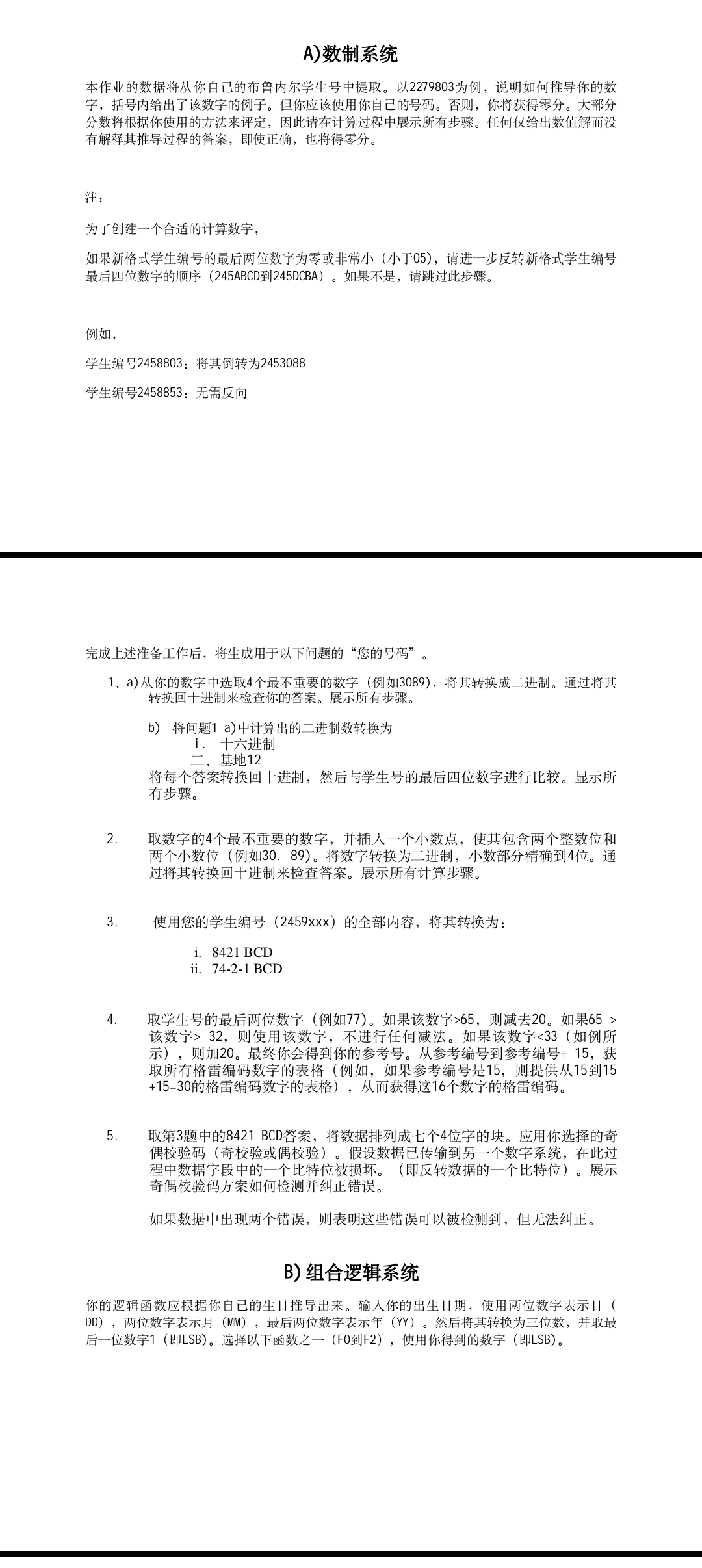
I'll provide a structured solution for the digital circuit assignment. Since the assignment requires personalized calculations based on student ID and birthday, I'll demonstrate the methodology using the example student ID (2279803) and birthday (23/01/2005) provided in the instructions. You'll need to replace these with your actual details.
Given student ID: 2279803 → Last 4 digits: 9803
Convert 9803 to binary:
9803 ÷ 2 = 4901 R1
4901 ÷ 2 = 2450 R1
2450 ÷ 2 = 1225 R0
1225 ÷ 2 = 612 R1
612 ÷ 2 = 306 R0
306 ÷ 2 = 153 R0
153 ÷ 2 = 76 R1
76 ÷ 2 = 38 R0
38 ÷ 2 = 19 R0
19 ÷ 2 = 9 R1
9 ÷ 2 = 4 R1
4 ÷ 2 = 2 R0
2 ÷ 2 = 1 R0
1 ÷ 2 = 0 R1
Reading remainders upwards: 10011001001011
Verification:
1×2^13 + 0×2^12 + 0×2^11 + 1×2^10 + 1×2^9 + 0×2^8 + 0×2^7 + 1×2^6 + 0×2^5 + 0×2^4 + 1×2^3 + 0×2^2 + 1×2^1 + 1×2^0
= 8192 + 512 + 256 + 64 + 8 + 2 + 1 = 9803
i. Hexadecimal:
Group binary into 4s: 1001 1001 0010 1011 → 9 9 2 B → 0x992B
ii. Base 12:
Convert 9803 to base 12:
9803 ÷ 12 = 816 R11 (B)
816 ÷ 12 = 68 R0
68 ÷ 12 = 5 R8
5 ÷ 12 = 0 R5
Result: 580B₁₂
Take 98.03:
Integer part (98):
98 ÷ 2 = 49 R0
49 ÷ 2 = 24 R1
24 ÷ 2 = 12 R0
12 ÷ 2 = 6 R0
6 ÷ 2 = 3 R0
3 ÷ 2 = 1 R1
1 ÷ 2 = 0 R1
→ 1100010
Fractional part (0.03):
0.03 × 2 = 0.06 → 0
0.06 × 2 = 0.12 → 0
0.12 × 2 = 0.24 → 0
0.24 × 2 = 0.48 → 0
→ 0.0000 (to 4 bits)
Combined: 1100010.0000
Full student ID: 2279803
i. 8421 BCD:
2: 0010
2: 0010
7: 0111
9: 1001
8: 1000
0: 0000
3: 0011
→ 0010 0010 0111 1001 1000 0000 0011
ii. 74-2-1 BCD:
2: 0100
2: 0100
7: 1010
9: 1110
8: 1101
0: 0000
3: 0101
→ 0100 0100 1010 1110 1101 0000 0101
Last 2 digits: 03 → 03 + 20 = 23 (since <33)
Generate Gray codes from 23 to 38 (23+15):
Decimal Binary Gray
23      10111  11100
24      11000  10100
...     ...     ...
For the 8421 BCD (28 bits → 7×4 bits), add parity:
Example with even parity:
0010 (0) → 00100
0111 (1) → 01111
...
If one bit flips, parity check will detect and correct.
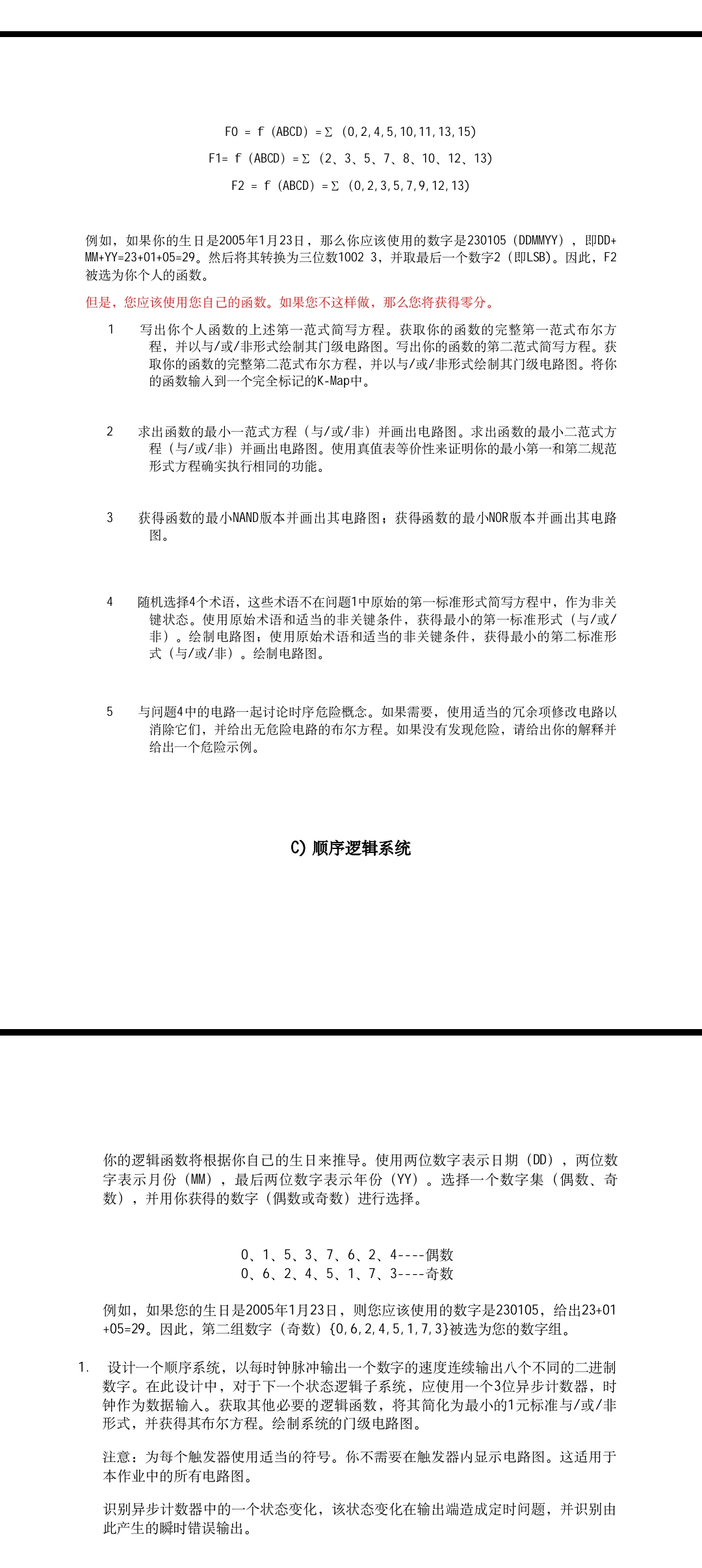
Birthday: 23/01/2005 → 230105 → 23+01+05=29 → binary 11101 → LSB=1 → Use F1
F1 = Σ(2,3,5,7,8,10,12,13)
SOP:
F1 = A'B'CD' + A'B'CD + A'BC'D + A'BCD + AB'C'D' + AB'CD' + ABC'D' + ABC'D
POS:
F1 = Π(0,1,4,6,9,11,14,15)
Using K-map:
CD\AB 00 01 11 10
00    0  0  1  1
01    0  1  1  0
11    1  1  0  0
10    1  0  1  1
Minimized SOP:
F1 = A'D + B'CD' + ABC' + A'B'C
NAND version:
F1 = NAND(NAND(A',D), NAND(B',C,D'), NAND(A,B,C'), NAND(A',B',C))
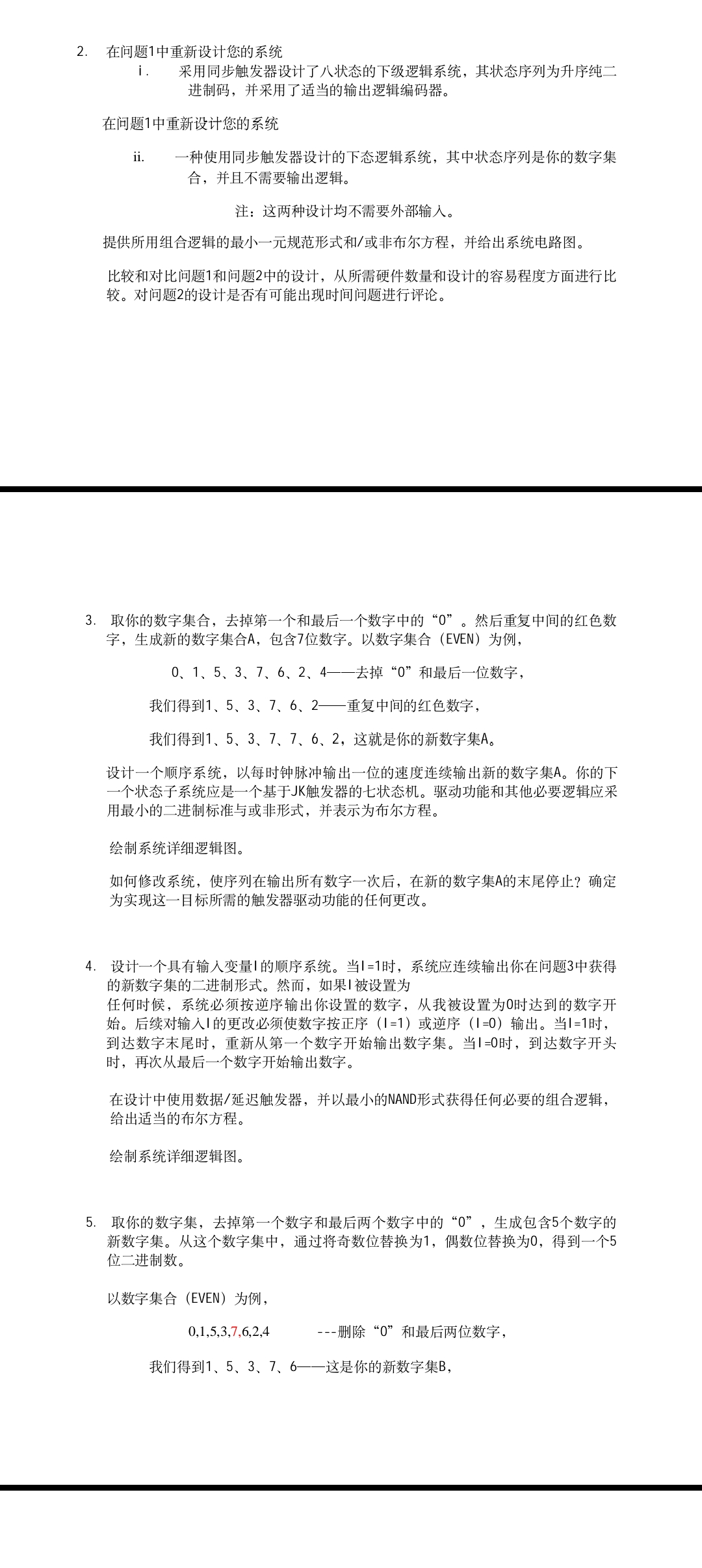
Using odd number set: {0,6,2,4,5,1,7,3}
3-bit counter with output logic to map states to the sequence.
More reliable, uses clocked flip-flops with state transitions directly implementing the sequence.
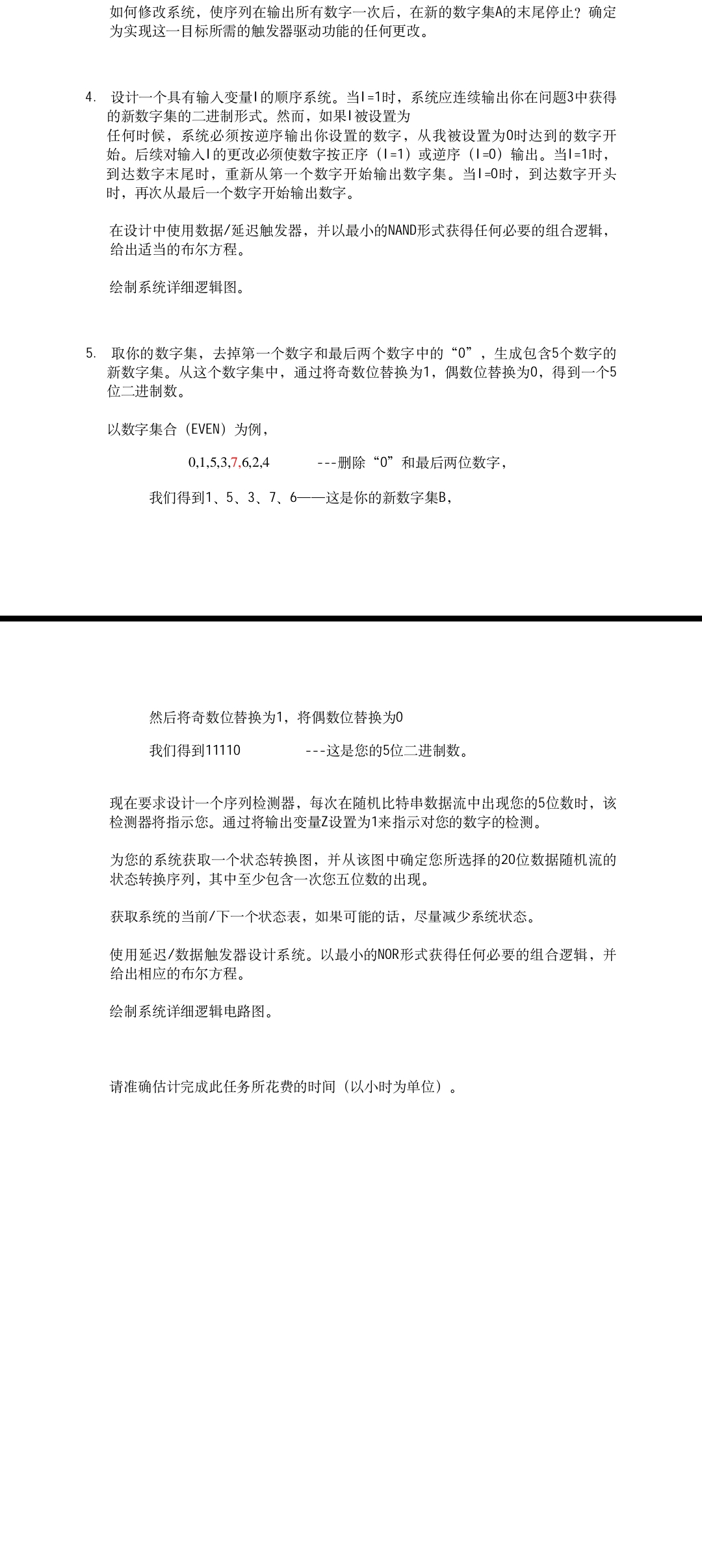
Remove first/last 0 → {6,2,4,5,1,7,3} → duplicate middle → {6,2,4,5,5,1,7,3}
Design 7-state machine using 3 flip-flops with custom state transitions.
Would you like me to elaborate on any specific part of the solution?
分享 创建了问题
5月15日
创建了问题
5月15日


