
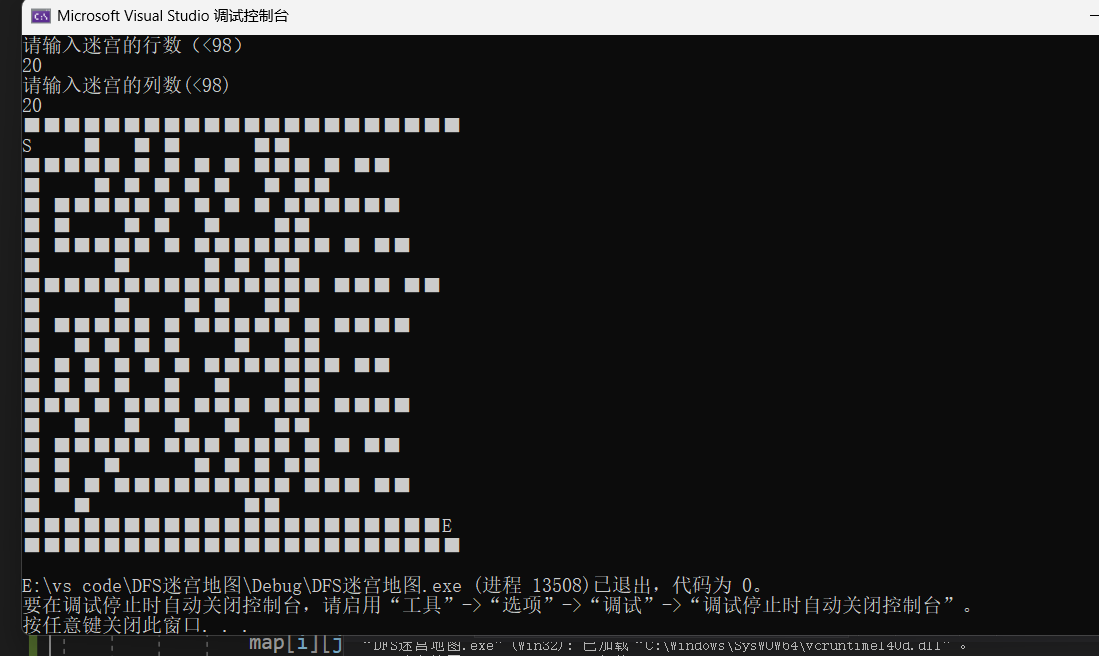
代码运行出来长这个样子,我写了3,4,个小时了,还是有问题,哪位朋友可以帮我看看吗,超级感谢
下面是我的代码
#include <iostream>
#include <cstdlib>
#include<ctime>
#include<algorithm>
using namespace std;
int  map[100][100];
int v[100][100];
//0未访问,1 访问
int dx[4] = { 0,1,0,-1 };
int dy[4] = { 1,0,-1,0 };
//初始化迷宫
void initMaze(int row, int column)
{
    for (int i = 0; i < row + 2; i++)
    {
        for (int j = 0; j < column + 2; j++)
        {
            if (i == 0 || i == row + 1 || j == 0 || j == column + 1)
            {
                map[i][j] = 1;
            }
            else
            {
                map[i][j] = 1;
                v[i][j] = 0;
            }
        }
    }
}
//DFS递归生成迷宫(带自然回溯)
void dfs(int x, int y,int row,int column)
{
    v[x][y] = 1;
    map[x][y] = 0;
    int dirs[4] = { 0,1,2,3 };
    for (int i = 0; i < 4; i++)
    {
        int r = rand() % 4;
        swap(dirs[i], dirs[r]);
    }
    for (int i = 0; i < 4; i++)
    {
        //int k = rand() % 4;
        int dir = dirs[i];
        int nx = x + dx[dir] * 2;
        int ny = y + dy[dir] * 2;
        if (nx > 0 && nx <= row && ny > 0 && ny <= column && v[nx][ny] == 0)
        {
            map[x + dx[dir]][y + dy[dir]] = 0;
            dfs(nx, ny, row, column);
        }
    }
}
//打印迷宫
void printmaze(int row,int column)
{
    for (int i = 0; i < row + 2; i++)
    {
        for (int j = 0; j < column + 2; j++)
        {
            if (i ==1 && j == 0)
            {
                cout << "S";
            }
            else if (i == row && j == column + 1)
            {
                cout << "E";
            }
            else if (map[i][j] == 1)
                cout << "■";
            else
            {
                cout << " ";
            }
        }
        cout << endl;
    }
}


int main()
{
    srand(time(0));
    cout << "请输入迷宫的行数(<98)" << endl;
    int row;
    cin >> row;
    cout << "请输入迷宫的列数(<98)" << endl;
    int column;
    cin >> column;
    initMaze(row,column);
    dfs(1, 1, row, column);
    printmaze(row, column);

    return 0;
}


