不限个数、互不相等的正整数组合,它们的平方根之和小数前十位数字为1234567890,求满足这一条件且和为最小的组合。
编程求得最小组合如下,和为249:3+6+7+10+12+13+14+42+66+76 = 249
它们的平方根之和小数前十位数字符合题意:
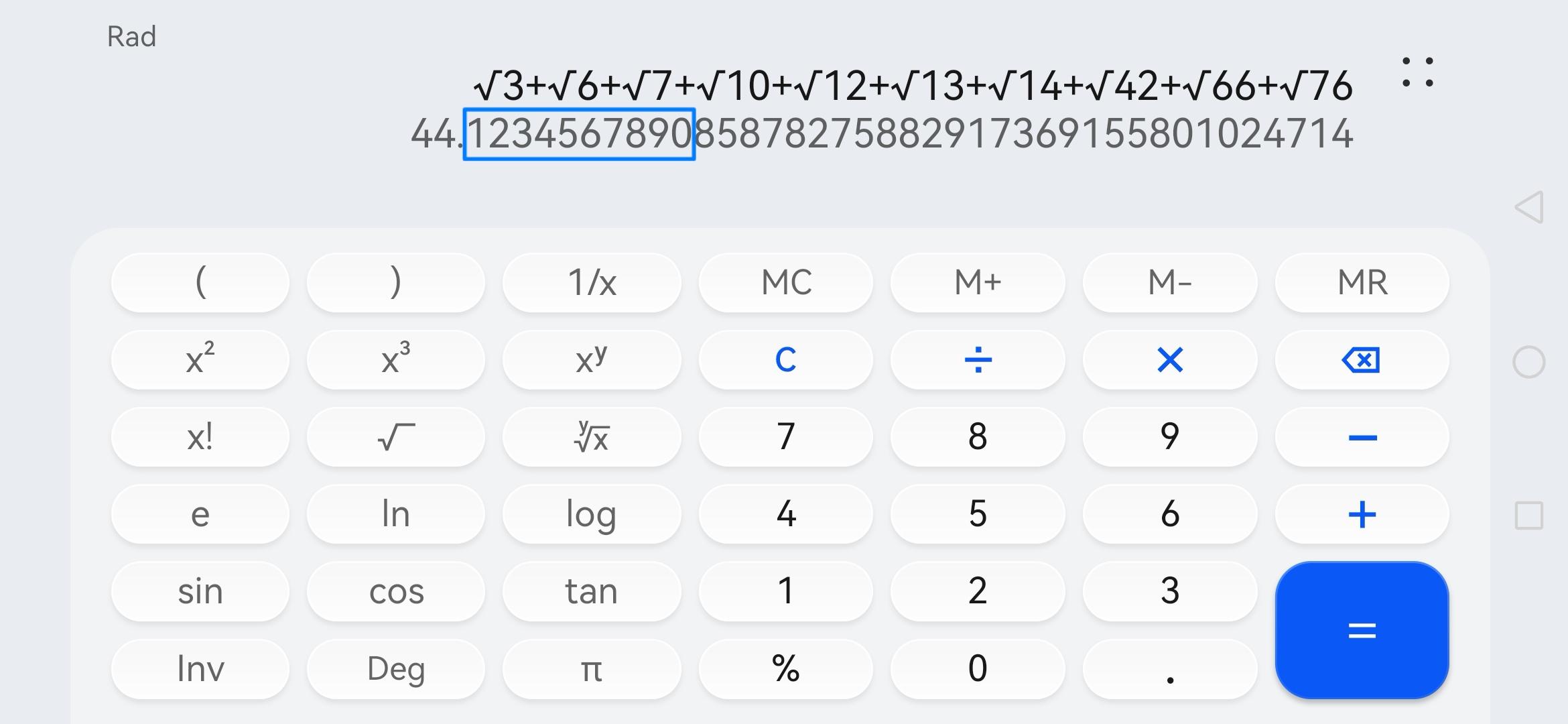
√3+√6+√7+√10+√12+√13+√14+√42+√66+√76
= 44.123456789085878275882917369155801024714…
计算耗时两分钟。
求更高效算法,并验证该结果是否为最小组合。

不限个数、互不相等的正整数组合,它们的平方根之和小数前十位数字为1234567890,求满足这一条件且和为最小的组合。
编程求得最小组合如下,和为249:3+6+7+10+12+13+14+42+66+76 = 249
它们的平方根之和小数前十位数字符合题意:
√3+√6+√7+√10+√12+√13+√14+√42+√66+√76
= 44.123456789085878275882917369155801024714…
计算耗时两分钟。
求更高效算法,并验证该结果是否为最小组合。
 分享
分享
Think about all possible combinations for 248 and other smaller values (>10 ** 15?). For each, one has to keep calculating until last number in that combination (whether is .1 or .12345 or any others). Sorting does not help, eg, x.1+y.2+z.3+w.4+a.1=a.1+x.1+y.2+z.3+w.4=b.1 (loop to the last value in either way to verify). So brutal force can only perform to certain extent. And n**0.5 probably randomly distributed (for n 1 to 248) in decimal part.
Unless there is math formula to apply on certain patterns, do not see any bypass any combinations without loop and calculation.
分享 系统已结题
9月17日
系统已结题
9月17日 已采纳回答
9月9日
修改了问题
8月28日
专家修改了标签
8月28日
已采纳回答
9月9日
修改了问题
8月28日
专家修改了标签
8月28日

