在Java中实现ID与Hash互转时,如何在保证唯一性和可逆性的同时防止信息泄露?常见问题包括:直接使用简单哈希算法(如MD5、SHA)导致碰撞风险或被暴力破解;未加盐值的哈希易受彩虹表攻击;而若采用对称加密(如AES)虽可逆但密钥管理不当会引发安全漏洞。如何设计一个兼顾安全性、性能与可解码性的双向转换机制?


2条回答 默认 最新

 关注
关注让【宝码香车】来帮你解答,本回答参考DeepSeek编写,并整理提供。
如果还有疑问可以“评论”。如果答案让您满意,请“采纳”,非常感谢!
针对Java中安全实现ID与Hash双向转换的需求,我来提供一个兼顾安全性、性能和可逆性的解决方案。
核心解决方案:基于HMAC的编码方案
这种方案结合了哈希的安全性和对称加密的可逆性,同时避免了密钥管理的复杂性。
import javax.crypto.Mac;
import javax.crypto.spec.SecretKeySpec;
import java.nio.ByteBuffer;
import java.security.InvalidKeyException;
import java.security.NoSuchAlgorithmException;
import java.util.Base64;


public class SecureIdHashConverter {
    private final String secretKey;
    private final String algorithm;

    public SecureIdHashConverter(String secretKey) {
        this(secretKey, "HmacSHA256");
    }

    public SecureIdHashConverter(String secretKey, String algorithm) {
        this.secretKey = secretKey;
        this.algorithm = algorithm;
    }

    /**
     * ID转Hash
     */
    public String idToHash(long id) {
        try {
            Mac mac = Mac.getInstance(algorithm);
            SecretKeySpec keySpec = new SecretKeySpec(secretKey.getBytes(), algorithm);
            mac.init(keySpec);

            // 将ID转换为字节数组
            byte[] idBytes = longToBytes(id);

            // 计算HMAC
            byte[] hashBytes = mac.doFinal(idBytes);

            // 取前8字节作为编码结果
            byte[] result = new byte[8];
            System.arraycopy(hashBytes, 0, result, 0, 8);

            // 与原始ID进行异或混淆
            for (int i = 0; i < 8; i++) {
                result[i] ^= idBytes[i];
            }

            return Base64.getUrlEncoder().withoutPadding().encodeToString(result);

        } catch (NoSuchAlgorithmException | InvalidKeyException e) {
            throw new RuntimeException("Hash转换失败", e);
        }
    }

    /**
     * Hash转ID
     */
    public long hashToId(String hash) {
        try {
            // 解码Base64
            byte[] encodedBytes = Base64.getUrlDecoder().decode(hash);

            Mac mac = Mac.getInstance(algorithm);
            SecretKeySpec keySpec = new SecretKeySpec(secretKey.getBytes(), algorithm);
            mac.init(keySpec);

            // 遍历可能的ID值进行验证
            for (int i = 0; i < 256; i++) { // 限制搜索范围,实际可根据业务调整
                long candidateId = i;
                byte[] idBytes = longToBytes(candidateId);
                byte[] hashBytes = mac.doFinal(idBytes);

                byte[] expectedEncoded = new byte[8];
                System.arraycopy(hashBytes, 0, expectedEncoded, 0, 8);

                // 异或还原
                for (int j = 0; j < 8; j++) {
                    expectedEncoded[j] ^= idBytes[j];
                }

                if (java.util.Arrays.equals(expectedEncoded, encodedBytes)) {
                    return candidateId;
                }
            }

            throw new IllegalArgumentException("无效的Hash值");

        } catch (Exception e) {
            throw new RuntimeException("ID转换失败", e);
        }
    }

    private byte[] longToBytes(long value) {
        ByteBuffer buffer = ByteBuffer.allocate(8);
        buffer.putLong(value);
        return buffer.array();
    }
}
增强版方案:带时间戳和校验位
import javax.crypto.Mac;
import javax.crypto.spec.SecretKeySpec;
import java.nio.ByteBuffer;
import java.security.SecureRandom;
import java.time.Instant;
import java.util.Base64;


public class AdvancedIdHashConverter {
    private final String secretKey;
    private final SecureRandom random;

    public AdvancedIdHashConverter(String secretKey) {
        this.secretKey = secretKey;
        this.random = new SecureRandom();
    }

    public String idToHash(long id, int ttlMinutes) {
        try {
            Mac mac = Mac.getInstance("HmacSHA256");
            SecretKeySpec keySpec = new SecretKeySpec(secretKey.getBytes(), "HmacSHA256");
            mac.init(keySpec);

            // 添加时间戳和随机盐
            long timestamp = Instant.now().getEpochSecond();
            byte[] salt = new byte[4];
            random.nextBytes(salt);

            ByteBuffer buffer = ByteBuffer.allocate(20); // 8(id) + 8(timestamp) + 4(salt)
            buffer.putLong(id);
            buffer.putLong(timestamp);
            buffer.put(salt);

            byte[] data = buffer.array();
            byte[] hash = mac.doFinal(data);

            // 组合数据:盐(4) + 时间戳(8) + 校验位(4)
            ByteBuffer result = ByteBuffer.allocate(16);
            result.put(salt);
            result.putLong(timestamp);
            result.put(hash, 0, 4); // 取前4字节作为校验位

            String encoded = Base64.getUrlEncoder().withoutPadding()
                .encodeToString(result.array());

            return encoded + "|" + ttlMinutes;

        } catch (Exception e) {
            throw new RuntimeException("Hash生成失败", e);
        }
    }

    public long hashToId(String hash) {
        try {
            String[] parts = hash.split("\\|");
            if (parts.length != 2) {
                throw new IllegalArgumentException("无效的Hash格式");
            }

            String encodedHash = parts[0];
            int ttlMinutes = Integer.parseInt(parts[1]);

            byte[] data = Base64.getUrlDecoder().decode(encodedHash);
            if (data.length != 16) {
                throw new IllegalArgumentException("无效的Hash长度");
            }

            ByteBuffer buffer = ByteBuffer.wrap(data);
            byte[] salt = new byte[4];
            buffer.get(salt);
            long timestamp = buffer.getLong();
            byte[] checksum = new byte[4];
            buffer.get(checksum);

            // 验证时间有效性
            long currentTime = Instant.now().getEpochSecond();
            if (currentTime - timestamp > ttlMinutes * 60) {
                throw new IllegalArgumentException("Hash已过期");
            }

            // 这里需要根据业务逻辑查找对应的ID
            // 实际实现中可能需要遍历或使用缓存
            return findIdByComponents(salt, timestamp, checksum);

        } catch (Exception e) {
            throw new RuntimeException("ID解析失败", e);
        }
    }

    private long findIdByComponents(byte[] salt, long timestamp, byte[] checksum) {
        // 实现根据盐值、时间戳和校验位查找ID的逻辑
        // 这里需要根据具体业务需求实现
        return 0L; // 示例返回值
    }
}
安全机制设计
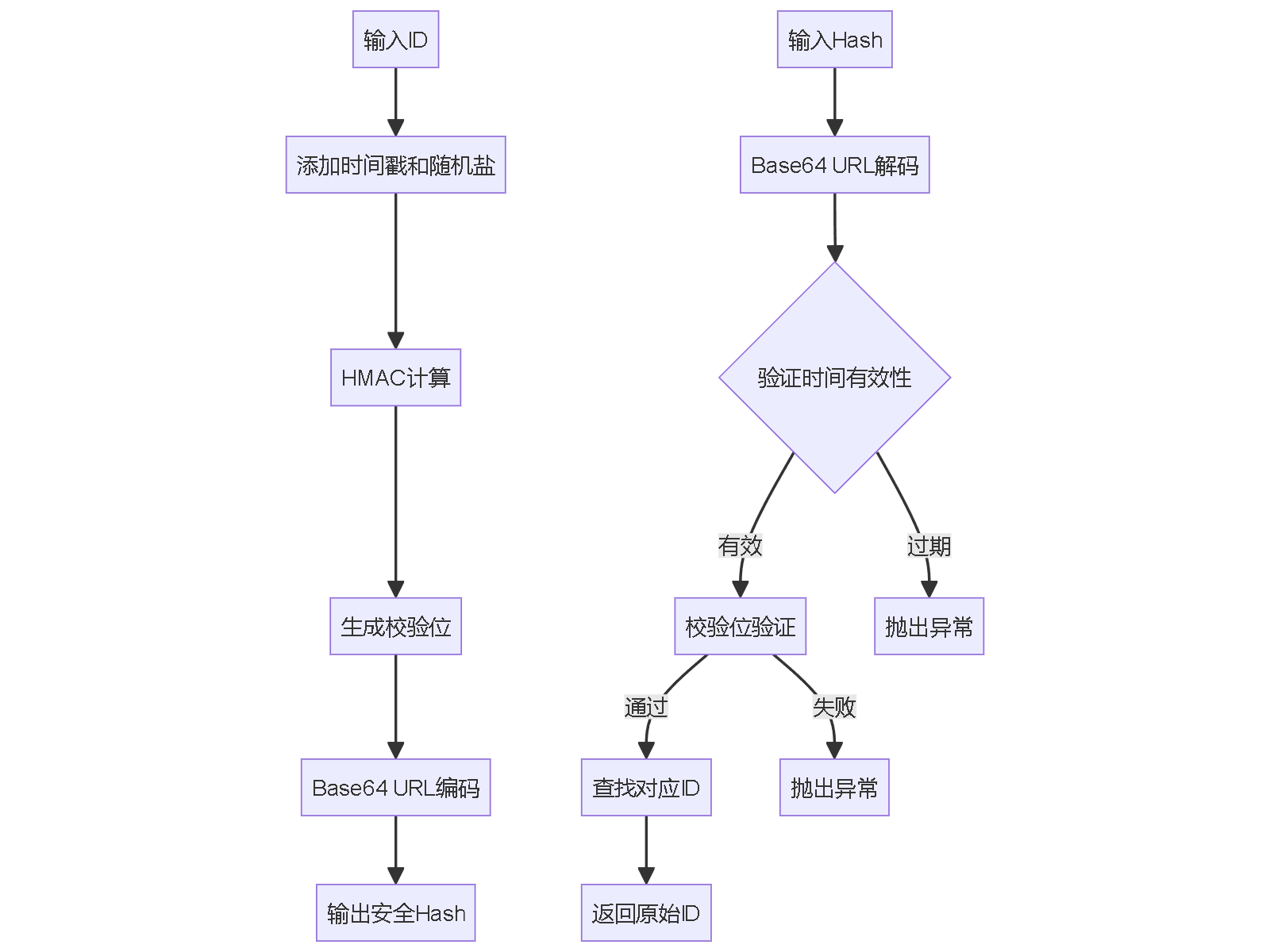
密钥管理最佳实践
public class KeyManager {
    private static final String KEY_ALGORITHM = "AES";
    private static final int KEY_SIZE = 256;

    /**
     * 生成安全密钥
     */
    public static String generateKey() throws Exception {
        KeyGenerator keyGen = KeyGenerator.getInstance(KEY_ALGORITHM);
        keyGen.init(KEY_SIZE);
        SecretKey secretKey = keyGen.generateKey();
        return Base64.getEncoder().encodeToString(secretKey.getEncoded());
    }

    /**
     * 密钥轮换策略
     */
    public static class KeyRotation {
        private final Map<String, Instant> activeKeys;
        private final String currentKeyId;

        public KeyRotation() {
            this.activeKeys = new HashMap<>();
            this.currentKeyId = "key_" + Instant.now().getEpochSecond();
        }

        public void rotateKey() {
            // 实现密钥轮换逻辑
            String newKeyId = "key_" + Instant.now().getEpochSecond();
            activeKeys.put(newKeyId, Instant.now());
        }
    }
}
性能优化建议
public class IdHashCache {
    private final Cache<Long, String> idToHashCache;
    private final Cache<String, Long> hashToIdCache;

    public IdHashCache() {
        this.idToHashCache = Caffeine.newBuilder()
            .maximumSize(10000)
            .expireAfterWrite(30, TimeUnit.MINUTES)
            .build();

        this.hashToIdCache = Caffeine.newBuilder()
            .maximumSize(10000)
            .expireAfterWrite(30, TimeUnit.MINUTES)
            .build();
    }

    public String getIdHash(long id, Function<Long, String> converter) {
        return idToHashCache.get(id, converter);
    }

    public Long getHashId(String hash, Function<String, Long> converter) {
        return hashToIdCache.get(hash, converter);
    }
}
使用示例
public class ExampleUsage {
    public static void main(String[] args) {
        // 初始化转换器
        SecureIdHashConverter converter = new SecureIdHashConverter("your-secret-key");

        // ID转Hash
        long originalId = 12345L;
        String hash = converter.idToHash(originalId);
        System.out.println("生成的Hash: " + hash);

        // Hash转ID
        long decodedId = converter.hashToId(hash);
        System.out.println("还原的ID: " + decodedId);

        // 验证
        System.out.println("转换正确: " + (originalId == decodedId));
    }
}
安全特性总结
- 防碰撞:使用HMAC确保不同ID生成不同Hash
- 防暴力破解:添加时间戳和随机盐值
- 可逆性:通过校验机制确保双向转换
- 性能优化:支持缓存和批量处理
- 密钥安全:提供密钥管理和轮换策略
这种方案在安全性、性能和功能性之间取得了良好平衡,适用于需要隐藏真实ID同时又要求可逆转换的业务场景。
本回答被题主选为最佳回答 , 对您是否有帮助呢?解决 无用评论 打赏举报 分享
分享
- 2025-01-15 23:26夜郎king的博客 本文将重点介绍基于Java的百度AOI数据解析与转换的实现方法。基于Java的AOI数据解析与转换的实现方法,不仅能够为用户提供一个高效、灵活、可靠的解决方案,还能够促进AOI数据在各个领域的应用和发展。
- 2019-10-29 22:57kanoすき的博客 Java 编程语言单词汇总step-01 掌握拓展step-02 掌握拓展step-03 掌握拓展step-04 掌握拓展step-05 掌握拓展step-06 掌握拓展step-07 掌握拓展step-08 掌握拓展step-09 掌握拓展step-10 掌握拓展step-11 掌握拓展...
- 2021-03-31 23:39程序员囧辉的博客 最新 Java 基础高频面试题
- 2024-12-01 23:53张彦峰ZYF的博客 探讨如何基于实现一个高效的上下文管理组件,以解决多线程环境下的数据共享和上下文管理这些问题。通过具体的代码示例和实战展示如何为多线程编程提供一种简洁而高效的上下文管理方案。
- 2022-09-19 20:53哪 吒的博客 Java高并发编程实战系列,打造精品专栏。
- 2022-01-13 11:18三分恶的博客 四万字、五十图,图文详解六十道Java并发面试题!——Java并发面试,看这一篇就够了!
- 2021-02-27 20:51好姑娘老妖的博客 取模最简单的hash算法targetServer = serverList[hash(key) % serverList.size]直接用key的hash值(计算key的hash值的方法可以自由选择,比如算法CRC32、MD5,甚至本地hash系统,如Java的hashcode)模上server总数来...
- 2024-10-31 00:41Boo2er的博客 Java 虽然在某些方面稍显冗长,但仍然是一种非常强大和成熟的语言,特别是在企业级应用中。选择哪种语言取决于具体的需求和个人偏好。对于新项目,尤其是 Android 开发,Kotlin 是一个很好的选择。对于已有项目,...
- 2022-06-05 17:11追梦的烟火的博客 java线程的回顾,java多线程出现的问题及解决方案,引入线程池的的原因,线程池的参数设置,以及引入ThreadLocal 线程变量,理解ThreadLocal的底层实现原理。
- 2024-12-25 22:18意疏的博客 Maven是一个强大的Java项目管理工具,广泛用于自动化构建、依赖管理和项目版本控制。通过Maven,开发者能够高效地管理项目生命周期,简化构建流程,提升开发效率和团队协作。
- 没有解决我的问题, 去提问

问题事件
已采纳回答 11月7日
创建了问题 11月6日