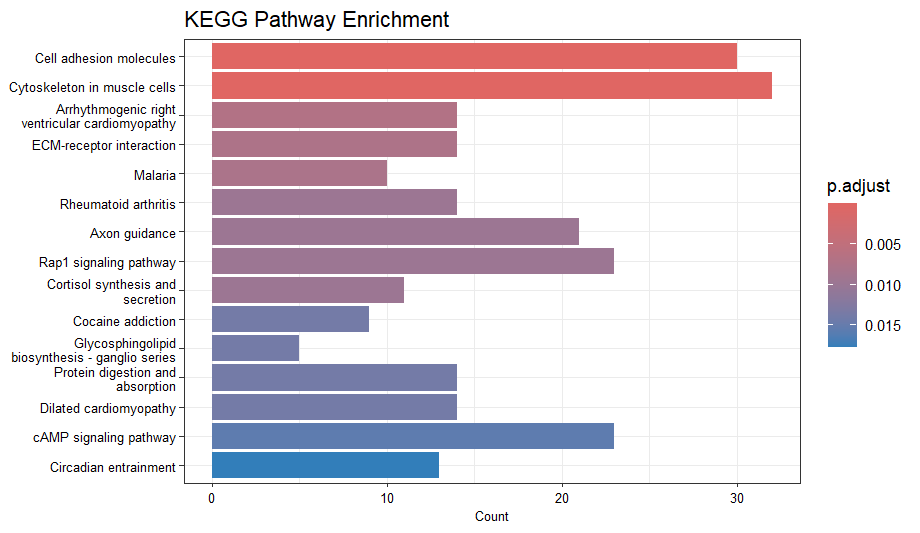
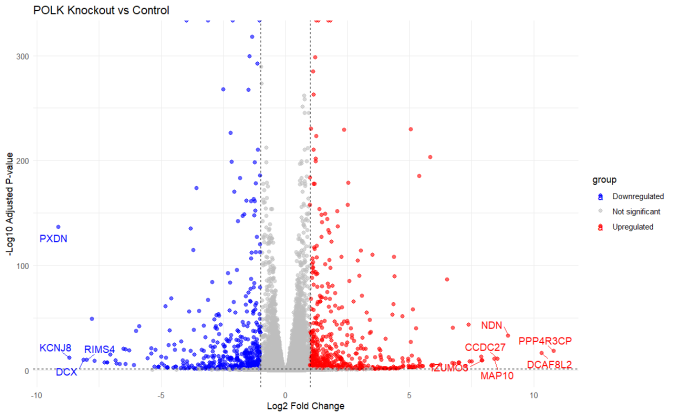
最近在暑期培训学习R语言,学习生物信息相关知识,但是本科完全没有学过,暑假还想学车,学艺不精还请各位海涵,想请教这个火山图好像有点丑陋了:(是不是我的代码哪里出问题了。数据是GSE145313
library(DESeq2)
library(tidyverse)
library(ggplot2)
library(ggrepel)
library(clusterProfiler)
library(org.Hs.eg.db)
# 1. 数据预处理
count_data <- GSE145313_POLK_raw_counts

clean_data <- count_data %>%
  filter(!is.na(Ensembl)) %>%
  distinct(Ensembl, .keep_all = TRUE)
# 2. 构建DESeq2对象
count_matrix <- clean_data %>%
  dplyr::select(-hgnc_symbol) %>%
  column_to_rownames("Ensembl") %>%
  as.matrix()

sample_info <- data.frame(
  sample = colnames(count_matrix),
  condition = factor(
    rep(c("Control", "POLK_KO"), each = 3),
    levels = c("Control", "POLK_KO")
  ),
  row.names = colnames(count_matrix)
)
# 3. 差异分析(添加低表达过滤)
dds <- DESeqDataSetFromMatrix(
  countData = count_matrix,
  colData = sample_info,
  design = ~ condition
)

# 过滤低表达基因(counts总和>10)
dds <- dds[rowSums(counts(dds)) > 10, ]
dds <- DESeq(dds)
# 4. 结果提取与注释
res <- results(
  dds,
  contrast = c("condition", "POLK_KO", "Control"),
  alpha = 0.05,
  #lfcThreshold = 1
)

res_annotated <- as.data.frame(res) %>%
  rownames_to_column("Ensembl") %>%
  left_join(
    distinct(clean_data, Ensembl, hgnc_symbol),
    by = "Ensembl"
  ) %>%
  relocate(hgnc_symbol, .after = Ensembl)
# 5. 质量控制
plotDispEsts(dds)# 检查离散度
vsd <- vst(dds, blind = FALSE)#  PCA分析
plotPCA(vsd, intgroup = "condition") +
  geom_label(aes(label = name))
sampleDists <- dist(t(assay(vsd)))
pheatmap::pheatmap(as.matrix(sampleDists))#样本相关性热图
# 6. 火山图
res_annotated <- res_annotated %>%
  mutate(
    group = case_when(
      padj < 0.05 & log2FoldChange > 1 ~ "Upregulated",
      padj < 0.05 & log2FoldChange < -1 ~ "Downregulated",
      TRUE ~ "Not significant"
    )
  )
# 仅标注显著差异基因中的top10
top10_sig <- res_annotated %>%
  filter(group %in% c("Upregulated", "Downregulated")) %>%
  arrange(desc(abs(log2FoldChange))) %>%
  head(10)

ggplot(res_annotated, aes(x = log2FoldChange, y = -log10(padj), color = group)) +
  geom_point(alpha = 0.6, size = 2) +
  scale_color_manual(values = c("blue", "grey", "red")) +
  geom_vline(xintercept = c(-1, 1), linetype = "dashed") +
  geom_hline(yintercept = -log10(0.05), linetype = "dashed") +
  geom_text_repel(
    data = top10_sig,
    aes(label = hgnc_symbol),
    size = 4,
    box.padding = 0.5,
    max.overlaps = 20
  ) +
  labs(
    title = "POLK Knockout vs Control",
    x = "Log2 Fold Change",
    y = "-Log10 Adjusted P-value"
  ) + theme_minimal()
# 7. 结果保存
write_csv(res_annotated, "DESeq2_full_results.csv")
# 保存显著差异基因(应用筛选条件)
sig_genes <- res_annotated %>%
  filter(padj < 0.05 & abs(log2FoldChange) > 1) %>%
  arrange(padj)

write_csv(sig_genes, "Significant_DEGs.csv")

# dotpic
# 从之前结果中提取显著差异基因(padj<0.05且|log2FoldChange|>1)
sig_genes <- res_annotated %>%
  filter(padj < 0.05 & abs(log2FoldChange) > 1)
# 1. 基因ID转换(Ensembl -> Entrez)
entrez_ids <- bitr(
  sig_genes$Ensembl,
  fromType = "ENSEMBL",
  toType = "ENTREZID",
  OrgDb = org.Hs.eg.db
)
# 2. KEGG富集分析
kegg_enrich <- enrichKEGG(
  gene = entrez_ids$ENTREZID,
  organism = "hsa",  # 人类KEGG代码
  keyType = "kegg",
  pvalueCutoff = 0.05,
  pAdjustMethod = "BH",
  qvalueCutoff = 0.2
)
# 3. 结果可视化
# 条形图(按计数排序)
barplot(kegg_enrich,
        showCategory = 15,
        title = "KEGG Pathway Enrichment",
        font.size = 8)
# 点图(综合展示富集水平)
dotplot(kegg_enrich,
        showCategory = 15,
        title = "KEGG Pathway Enrichment")

# 4. 保存结果
write_csv(as.data.frame(kegg_enrich), "KEGG_Enrichment_Results.csv")